Political power rests firmly upon declarations about life that are true.

A lot of negative press coverage has failed to dislodge Donald Trump from his political ascent.  How does he succeed so well in politics while other more experienced politicians fail to garner the public’s interest?  Here’s a quote from Hannah Arendt’s book published in 1958 entitled The Human Condition, “Where power is not actualized, it passes away, and history is full of examples that the greatest material riches cannot compensate for this loss.  Power is actualized only where word and deed have not parted company, where words are not empty and deeds not brutal, where words are not used to veil intentions but to disclose realities, and deeds are not used to violate and destroy but to establish relations and create new realities.”

Her discussion began by recognizing how important words and actions are to the power that resides in politics.  An establishment politician that tailors his political rhetoric to suit political views or political propaganda nested in the past can’t gain the power needed to do anything new and a politician can’t recruit new supporters without being ready to acknowledge changes and to suggest a game plan that deals with change.

The neoliberal economy isn’t providing opportunities for small capital holders, the working class, even the middle class.  When President Obama said that, “Anyone claiming that America’s economy is in decline is peddling fiction,” it didn’t sound true to the long-term unemployed that have been ignored in the frequently cited 5.5% unemployment statistic .  It worries Americans that there aren’t enough jobs and there’s fewer good jobs.  President Obama knows that there’s a lot of unemployed working age people.  When President Obama failed in his speech to pair his mention of a squeeze on labor with a plan of action, he destroyed his opportunity to suggest a way to improve a domestic economy that once had enough jobs.  Mr. Obama’s nod to those being squeezed didn’t mention particulars and his declarations denying economic decline didn’t convince anyone that opportunity or prosperity is growing in America.

Donald Trump’s secret political sauce is just saying that he sees an economy that’s falling short of its potential for greatness.  And he says that he sees an opportunity to get the economy moving again.  We all see that the economy is not providing opportunities for most Americans.  Recognizing economic problems and advocating policy changes is where Trump’s political power comes from.  You or I may not agree with some of his political positions but he gains power whenever he acknowledges economic harms and worries in the United States.  Economic insecurity grows bigger everyday because the economy is shrinking.  Policy reform could change that.  Right now, there are economic policy threats to each American’s economic security.  For example, under Dodd Frank, banks can use a “bail in” to steal deposits if there’s another financial emergency that would cause a bank failure; so much for FDIC.  And banks that are too big have monopoly effects in how they use money; this warps prices and values for goods and services.  Deregulated banks don’t protect their own solvency by keeping an adequate equity backstop compared to the risks that they take, and Wall Street gambles with derivatives instead of following a more prudent course by investing in production.

It turns out that political power comes from recognizing harms.  And political action starts with a conversation about harms.  A politician who wants more power should try to address harms that have happened because of bad policies.  He should identify which policies are bad and say why we should change them.  And he can offer suggestions about how to strengthen our economy with better policies for the benefit of more people.

Source: Hannah Arendt, The Human Condition, Second Edition, (The University of Chicago Press, Chicago, 1958), 200.

All text on this blog is copyrighted to Mel Scanlan Stahl. It is subject to fair use standards.  If you should refer to my blog posts or blog pages please acknowledge me as the source.  And please leave a comment to let me know what you think about what you read here.

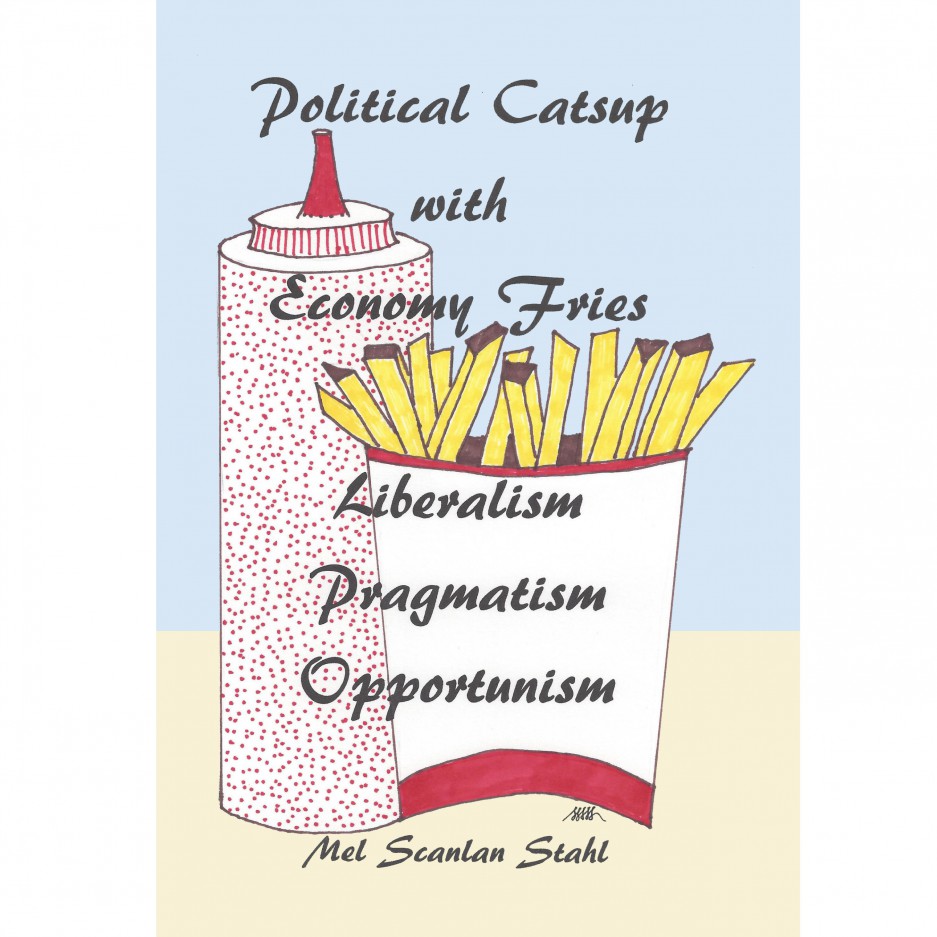
Buy Political Catsup with Economy Fries at Amazon.com

Time has passed since I wrote the content above.  Since then, Donald Trump scored more delegates on Super Tuesday (Mar 1st, 2016) than any other Republican frontrunner.  I have been amazed at the intensity of attacks against Donald Trump from the Republican leadership (even though he’s their leading Republican candidate).  And I wondered why the Republican establishment would oppose his candidacy for President when he is in the lead.  To discover more, I found this article on The Economic Populist.  It explains strategic reasons that the author would vote for Donald Trump.  He sees Donald Trump as genuinely Conservative in his nationalist trade agenda (as compared to a post-nationalist neoliberal trade agenda) and in his desire to restrict immigration (a desire to protect national security).  See what you think about these arguments.

Lengthy legislation reflects problems in the legislature.

According to a famous historian from the Roman Empire, Tacitus (56-117 AD), “The more corrupt the state, the more numerous the laws.”  (1) (2)

Some recent laws passed by the U.S. Congress have been really lengthy.  For example the Affordable Care Act was 2,400 pages (381,517 words)(3).  Follow-up expansion of regulations having to do with enforcing the ACA ran to 11,588,500 words (4).  That’s thirty times longer than the ACA itself.  Whew!  The No Child Left Behind bill of 2001 had more than 1,000 pages and 274,559 words.

According to one source, complexity aids those who know how to navigate complex and convoluted pages of legislation (5).  And that can help special interests as they become experts at how to get around a law.  It may also help Congress members to be less accountable for all of the diffuse information in a bill.  A Congress member can say that they didn’t read the bill because there wasn’t enough time to read it before a vote was required after months of negotiations.  We have heard this excuse many times in the recent past.  Or a Congress member can claim that they would never agree to all of the provisions except that they were a necessary part of political compromise.

One thing’s for sure.  Simpler and shorter laws could be better for our nation.  Shorter laws would reduce special interest influence.  And also could reduce confusions regarding enforcement.  Confusing laws might lead to selective enforcement or other enforcement problems.  Laws should be easy to understand and making them impossible to understand because they are too long and complicated is a bad strategy if we want the nation to be strong politically and economically.  Not all of the laws being passed are so very long.  But laws having to do with how money will be spent or how people will be taxed seem to have become too long indeed.

Perhaps it’s time for the legislature to look at this problem and limit the length of text allowed in new legislation.  And of course there are more than a million laws that already exist and some of them should probably go away to streamline our body of legislation and make it less costly and more enforceable.  Do you think that our Congress members would ever reduce the length and the number of laws?  Should they?

Sources: (1) Wikipedia, enwikipedia.org/wiki/Tacitus, accessed 29 Dec 2015.

(2) Brainyquote, http://www.brainyquote.com/quotes/t/tacitus169570.html, accessed 29 Dec 2015.

(3) The Economist, 23 Nov 2013, from the print edition, http://www.economist.com/news/united-states/21590368-why-congress-writes-such-long-laws-outrageous-bills, accessed 29 Dec 2015.

(4) 11,588,500 Words: Obamacare Regs.30x as Long as Law, Penny Starr, Oct 14, 2013, cnsnews.com/news/article/penny-starr/1158500-words-obamacare-regs-x30-long-law, accessed 29 Dec 2015.

(5) “For Bills in Congress, How Long is Long?, 24 Nov, 2009, http://www.opencongress.org/articles/view/1375-For-Bills-in-Congress-How-Long-is-Long, accessed 29 Dec 2015.

All text on this blog is copyrighted to Mel Scanlan Stahl. If you should refer to my blog posts or blog pages please acknowledge me as the source.

War leads eventually to economic collapse and political disorder.


Andrew Bacevich related a quote from one of the nation’s Founders.  It was written early in American history but has bearing on today’s events.  According to Bacevich, in 1795, James Madison wrote: “war is perhaps the most to be dreaded, because it comprises and develops the germ of every other.  War is the parent of armies.  From these proceed debts and taxes.  And armies, debts and taxes are the known instruments for bringing the many under dominion of the few…No nation could preserve its freedom in the midst of continual warfare.”

Here’s a reminder of how many U.S. dollar-funded (debts still owed) Middle Eastern Wars have been ongoing: Persian Gulf War: 1990-1991, Iraq War, 2003-2010,  Afghanistan/Other 2001-2010,   and of course our advisors and Special Forces are still active in the Middle East.  According to one source, Iraq and Afghanistan Wars cost more than 4 trillion dollars.

President Obama in his speech on 6th Dec, 2015, called for more military action: “Finally, if Congress believes, as I do, that we are at war with ISIL, it should go ahead and vote to authorize the continued use of military force against these terrorists.  For over a year, I have ordered our military to take thousands of airstrikes against ISIL targets.  I think it’s time for Congress to vote to demonstrate that the American people are united, and committed to this fight.”  Never at any point in his speech did President Obama voice doubts about whether military actions in the Middle East should continue.  And he should have doubts because disorder there has only increased since the United States started making war in the Middle East.

Deepak Lal wrote a book that discussed American empire aspirations that have affected American foreign policy since the neoliberal era began after WWII.  Most Americans, according to Lal, by contrast, advocate for strategies under the Wilsonian doctrine of supporting equally sovereign nations.  Most ordinary Americans don’t have an empire sized ambition to control world politics.  But during the neoliberal era, many politicians in American government have sought to influence global politics through military actions.  The U.S. military has been used to enforce U.S. hegemony in far away places by establishing hundreds of military bases.  Here’s Lal’s quote,

As most of the failed or failing states in Africa and the Middle East are rich in the natural resources whose rents have been misused by their predatory elites, a depoliticization of these rents is required to restore order.  An INRF (International Natural Resources Fund) maybe the answer.”  Has the level of disorder in Syria risen to the level of depoliticization?  Political order in Syria seems to have fled and Vladmir Putin criticized U.S. military actions in the Middle East for causing more political disorder there.

Recently, Russia has pushed back against the U.S.’s continuing ambition to influence politics in the Middle East by utilizing military force.  What everyone can see is that military conflicts are on the rise.  And U.S. debt has far surpassed numbers that are easy for Americans to understand (almost 19 trillion dollars).  And continued warfare will continue to rob prosperity from the American economy.  Our government’s empire project has surpassed what is affordable and its lingering debt has become oppressive.  But that’s not all.

The War on Terror has also been used to justify curtailing the rights of ordinary law-abiding Americans.  Constant surveillance of meta-data, although ruled in American courts as unconstitutional  has continued.  Restriction of Second Amendment rights and First Amendment rights, Fourth Amendment rights, Fifth Amendment rights and other rights that belong to all Americans have been called for repeatedly and the spoken urgency for restricting freedoms seems to be increasing as politicians call for further restricting everyone’s rights .  The purpose of the U.S. Constitution is to limit the power of government and to protect natural rights (as only partially listed in the Bill of Rights).  This creates political interests in common and prevents some forms of political predation against less powerful Americans.

Although some politicians would ignore the U.S. Constitution they should not do so because ignoring the U.S. Constitution is political aggression against political order.  So even though President Obama calls for more Second Amendment restrictions and more warfare, it’s important to respect the U.S. Constitution’s protections which serve to prevent political predators from harming law-abiders.  As for the San Bernardino shooters, they are both dead.  And if they weren’t dead, they would have been arrested and prevented from causing further harms.  The goal of law enforcement is to protect Americans from violence by penalizing the violent.  Law enforcement can act as a deterrent to violence but preventing violence isn’t a goal that can work for us.  That’s because preventing violence isn’t possible.  And further curtailing American freedoms is only a form of tyranny.  The U.S. Constitution is meant to create political order by preventing the political abuses of tyranny by limiting the power of government.  Increasing the government’s power won’t protect anyone.

Finally, the United Kingdom was the last empire class nation and it had a global monetary system that worked to stabilize currency and commodity values.  It was the strict gold standard.  Part of the unrest in the world today, is being caused by the failure of a fiat monetary system to stabilize economic prices and values.  Instead, monetary instability continues.  This instability harms businesses and stimulates global political aggression.  Rather than reaching for a political solution based on bombs, soldiers or advisors, a better solution would be to address stability problems in the global monetary system.

To get more even more connections between politics and economics, buy Political Catsup with Economy Fries at Amazon.com

Sources: James Madison quote in, Andrew J. Bacevich, The New American Militarism: How Americans Are Seduced by War, (Oxford University Press, New York, 2005), 7.

Deepak, Lal, In Praise of Empires: Globalization and Order, (Palgrave MacMillan, New York, 2004), 104.

Stephen Daggett, “Cost of Major U.S. Wars, Congressional Research Service, 7-5700, June 29, 2010, http://www.crs.gov, fas.org/sgp/crs/natsec/RS22926.pdf accessed 2014.

Pierce Nahigyan, NationofChange/News Report, 18 Feb. 2014, “Wars In Afghanistan, Iraq to Cost U.S. Over $4 Trillion”, http://www.nationofchange.org/wars-afghanistan-iraq-cost-us-over-4-trillion-1392732855/, accessed 2015.

All text on this blog is copyrighted to Mel Scanlan Stahl. If you should refer to my blog posts or blog pages please acknowledge me as the source.

Power and language partner-up in politics.


According to Alexis de Tocqueville, writing in about 1835, Americans would “talk politics” at the slightest opportunity.  “The cares of politics engross a prominent place in the occupations of a citizen in the United States; and almost the only pleasure which an American knows is to take a part in the government, and to discuss its measures.  This feeling pervades the most trifling habits of life…”  This contrasts sharply with today’s American political involvement.

Special interests have become so powerful that individuals can’t discuss politics outside of special interest topics.  Inside families, one generation may even disagree with another.  Seldom do people consider U.S. politics on the basis of clear information or political history, where people could perhaps share a common American heritage.  The twenty-first century finds political discussions happening in think tanks and lobby groups in America where big money provides bigger political access.  But think tanks and lobbies don’t relate well to American political values at the grassroots.

In 1958, Hannah Arendt wrote about the specialized jargon being used in the sciences and she saw jargon as making a discussion of politics harder–maybe even impossible.  She wrote “Wherever the relevance of speech is at stake, matters become political by definition, for speech is what makes man a political being.”  As Americans begin to realize that “talking politics” and finding common political ground is harder, as we realize that many recent graduates never studied civics or never read the Declaration of Independence or the U.S. Constitution, the missing language that would aid us all in political discourse seems important–even necessary.

Making the connections between our American political past and present is something that Political Catsup with Economy Fries can help you to achieve.  And understanding political changes can help you to understand economic changes too.  Americans from Alexis de Tocqueville’s time shared a passion for politics in part because they were united in seeking political policies that would aid American prosperity at home.  Wouldn’t it be great to engage in the old American past-time of “talking politics” at the kitchen table over the meat and potatoes or at the market shopping with your friend or during a weekend baseball game?

Buy Political Catsup with Economy Fries at Amazon.com

Sources: Alexis de Tocqueville, Democracy in America, Richard Heffner, ed., (Signet Classics, New American Library, Inc., New York, 1956), original publication 1835, 109.

Hannah Arendt, The Human Condition, with Margaret Canovan, (University of Chicago Press, Chicago, 1958), 3.

All text on this blog is copyrighted to Mel Scanlan Stahl. If you should refer to my blog posts or blog pages please acknowledge me as the source.

The many purposes of the free press

My library has three sources that discuss freedom of the press in similar ways.  To my surprise these books written by different authors have similar findings but for different historical periods in different nations.  Here are the references:

1, Modris Eksteins, The Limits of Reason: The German Democratic Press and the Collapse of the Weimar Democracy, (Oxford University Press, London, 1975).

2. George Orwell, Essays, “The Freedom of the Press (Animal Farm), London, 17 August 1945, New York, 26 August 1946″, (Everyman’s Library, Alfred A. Knopf, a division of Random House, New York, 1968, copyright held by Sonia Brownell Orwell and renewed by Mark Hamilton, 1998).

3. Edward S. Herman, Noam Chomsky, Manufacturing Consent: The Political Economy of the Mass Media, (Pantheon Books, New York, a division of Random House, 1988, 2002, copyright held by authors).

The Limits of Reason addresses freedom of the press in 1933 during the collapse of the democratic Weimar republic, in Germany, when the nation was beset by economic problems after WWI before WWII.  Orwell’s essay discusses journalism and other outlets for political opinion in England near the end of WWII.  Manufacturing Consent discusses journalism in the U.S. during the last quarter of the twentieth century.   I expected that their descriptions of the press in different nations would differ substantially but they sounded similar instead.

That’s because these authors were discussing the limitations of a “free” press in an economy and political system facing challenges.  They listed lots of related ideas.  For example, a free press has bills to pay and advertisers may expect a non-controversial publication that makes readers feel friendly toward the products being advertised.  Why encourage anxiety when advertisers just want people to buy?

Buy Political Catsup with Economy Fries at Amazon.com

A publication can be owned by economic interests that have common views based upon their economic intentions. Perhaps politics to those in power seems uncontroversial because their own interests are being well served.  Advertising revenue might be endangered if a sponsor were to become offended.  And sales from books or newspapers may be slimmer when people have less disposable income.  That might make research journalism too expensive.  Or in a national climate of similar viewpoints that serve a political establishment, making the case for an alternative viewpoint can require more time than a beleaguered press can afford.  Or the public may hear certain establishment views so frequently that presenting an alternative can beckon readers to expend more time than they are willing to invest in order to understand deeper issues.

Modris Eksteins admitted that the liberal German press was curtailed in what it could print.  But intellectual discussions of politics were possible and had a long tradition.  Journalists hoped that by arguing in favor of morally good political outcomes that would benefit many groups, the liberal press could shore up the Weimar Republic.  But after economic problems became incurable, German newspapers couldn’t find a way to strengthen a failing political system.  “Economic and political disorientation provoked these crises and in the end left these firms devoid of political initiative and uncertain of their political role.” (Eksteins, p310)  Here it sounds as though the press ran out of ways to strengthen a failing political system.  And persecution of Jews in Germany had already begun and undermined Jewish writers who had been an important part of German journalism. After Goebbels took over the German press, the families that had owned newspapers lost them.  But what’s interesting is that failure of the press to find any answers to the problems that beset Germany had already happened and it happened first.  Goebbels took over after that.  Before I read this book, I thought that Germany’s press had been politically taken over by the Nazis and politically co-opted.  I hadn’t understood that there was a prior failure to shape a dialogue that offered any other solution than a Nazi future.

The Orwell essay expressed the idea of “voluntary censorship.”  This idea is  related to the failure of vision seen in Weimar Germany in 1933 that Eksteins discussed.  But it happened in England during WWII, and it began with trying write whatever would encourage England to win the war.  Orwell wrote about “intellectual cowardice” being a threat to writers and journalists.  Orwell wrote about an “orthodoxy of ideas” and centralization of press ownership in England.  Certain ideas were simply not published.  He argued that “Tolerance and decency are deeply rooted in England, but they are not indestructible, and they have to be kept alive partly by conscious effort.”  He warned that pruning the literary tree for the sake of “political expediency” could undermine a free press.  Orwell wrote “If liberty means anything at all it means the right to tell people what they do not want to hear.”  And that is usually the stuff that is outside political orthodoxy.  Political and economic stressors can affect journalism and reduce the journalistic investment in an open minded, open-ended press. But the need for open mindedness can be even greater in a desperate race to discover better solutions to policy problems.

Herman and Chomsky wrote a careful analysis using critical methodology to measure how press coverage in the 1970’s, 1980’s and 1990’s deviated from “reporting the facts” and into the territory of political messaging, propaganda and censorship.  They wrote that press coverage in a few concentrated privately owned media companies leads to incomplete coverage that is biased in favor of corporate and government views.  Journalist coverage shapes political opinion to conform to certain political characterizations that can treat violence differently depending on which group acts.  U.S. allies are characterized positively, and those who don’t ally themselves with American political objectives are described negatively.  It has become impossible for Americans to understand political happenings (Herman, Chomsky, p303, with Bagdikian).  Here again, there’s a failure of journalistic vision.  But the authors say that open-minded, critical journalism isn’t rewarded.  Instead of rewarding open-minded journalism, canned establishment views predominate and these are rewarded.  That’s why mainstream journalistic failures to inform the public meaningfully about issues become commonplace (Herman, Chomsky, p303, 304).

All three sources discussed the press’ failure to meet the challenge of understanding a new point of view in an atmosphere of established viewpoints.  It seems that even when established views don’t deliver people from a dismal present, they sometimes persist.  They have a kind of inertia that can be hard to overcome.  And most people don’t have time to research to discover alternative viewpoints.  But these writers, Eksteins, Orwell, Herman and Chomsky, also wished that a free press could deliver better viewpoints that might save us all from an unfortunate political or economic outcome.  And they viewed “the truth” as not elusive in terms of understanding but rather more commonly elusive in terms of reporting and often because of self censorship (inside a system that rewards self censorship) or self-doubt (inside a system that is failing).  Every person sometimes needs an antidote to prevailing viewpoints.  How else can we adapt to a changing world?

All text on this blog is copyrighted to Mel Scanlan Stahl. If you should refer to my blog posts or blog pages please acknowledge me as the source.