Pig therapy for Congress.

Wow!  I wonder when people will be done wigging-out over President Trump.  I continue to hear hissy-fits about Trump as President.  Has he been acting too Presidential?  Do his real activities lack sufficient drama?  So imaginary non-events continue to be fabricated and accusations based on gossip are being reported as though they’re real.  Hysteria ensues.  And all at the expense of real work that our legislature needs to do to fix our economy.  Shame on the gossip sharing press and on Congress members that take this bait.

When Congress has bickered again and failed to fix the problems that they are causing I have sometimes wondered what new tasks they can be assigned that would bring their focus back to the people’s business.  I have imagined that a successful pig farmer can loan each Congress member their very own full-grown pig.  The farmer will collect a pig rental fee.  And the Congress member will be required to keep the pig in good health and happiness for a year on a fixed budget in order to continue their service in office.  I realize that most Congress members are wealthy and wouldn’t know how to care for a farm animal or stay within a budget.  But they should try to learn something new.  Part of America’s problem with Congress is that Congress members aren’t learning from their mistakes and making the needed policy changes to improve our nation.  Pig therapy might be just what Congress needs.

Congress members will bring their pig into the Congressional chambers so that they will be reminded that real living beings depend on the legislature to do the right thing.  Writing legislation with people in mind might be easier with a living and breathing reminder-pig at hand.  If Congress members find pigs in the legislature to be too messy, they can choose a different venue.  Meeting in a new place might give them new ideas.  Keeping pigs will remind Congress members that living beings, pigs or people need attention, food, a clean environment, and that if they are ignored too long, they will become restive.

I would like each Congress member to pay the pig tax so that they will remember that taxes can make keeping a pig unaffordable.  I would like them to pay veterinarian fees so that they will be reminded that expensive healthcare can make keeping a healthy pig hard to do.  K-Street will be converted into a farmer’s market where the Congress member will buy food for their pig instead of visiting lobbyists.  There on K-Street, they can converse about pigs and the business of pig prosperity with other Congressional pig farmers.  And each Congress member will have to clean up after their pig to be reminded that Congress members should clean up the messes that they make.  Likewise, Congress will write their own laws–no more un-elected bureaucrats or think-tanks writing legislation.  Congress members will not be allowed to hire a pig keeper.  Their pig will be their responsibility.

Right now, the United States is in trouble.  Taxes are too high but the government continues to overspend.  Almost ten years have passed since the Great Recession and the economy is practically at a standstill.  Interest rates are being kept low because of government debt and that hurts people who normally would receive interest on their savings.  Government debt is also being used as an excuse for overtaxing people more and never lowering taxes.  And Congress continues never-changing bad laws in the United States that have harmed prosperity.  Although there was some policy analysis in Congress in favor of repealing bad laws and fixing the economy when President Trump entered office, any changes have been blocked by nonsensical Trump complaints.  Change is needed because there’s a lot of trouble out there.

Americans can hardly make a move without being charged double for everything.  Getting a good job is harder and there’s less opportunity because so many middle class jobs have disappeared.  Tuition has doubled over the last ten years in some places.  Jobs aren’t secure for degree holders or for non-degree holders.  Real estate has been inflated dramatically (in some places it has doubled since 2010).  Healthcare has inflated (500% inflation of insulin over the last ten-year period).  Food has inflated (skirt steak at $13.95 per pound last year).  Forty nine million, or 49,000,000 Americans are living in poverty right now according to wikipedia (https://en.wikipedia.org/wiki/ Poverty_in_the_United_States).  Financialization after bank deregulation has put the advantageous use of capital at the apex of society where wealthy corporations can engage in huge capital risk but ordinary Americans suffer the consequences.  For most people this is a no-fun economy.  And in the no-fun economy, so much that once was possible for so many is now impossible.

And the growth of the newly impossible will continue because it begins with a sick economy that has grown sick under economic interventionism machined into existence, fitted into place and welded in by Congress.  Economic interventionism has been profitable for some but disastrous for others.  Consequences reverberate and vibrate all around us, louder and louder.  Now, our ability to recover economically is declining because some professions are failing to train and educate the next generation of workers.  There is now a decline in university attendance.  That means that there will be fewer professionals and educated persons.  There’s a growing shortage in many trades that can’t now provide a living wage that can stand up to insecure employment that comes and goes, high healthcare costs, high taxes, low profits.  These are clear warning signs.

Both the Democrats and Republicans have forgotten how to legislate for outcomes that help ordinary people.  When they oppose the other party, they actually work together to block changes that are needed.  I ask Congress for activism not opportunism and obstructionism.  I ask Congress to think like a farmer and stop thinking like a lawyer or a banker.  I ask everyone for a moratorium on Trump hysteria.  I suggest that Congress get down to doing the people’s business.  If they can’t do the people’s business, perhaps they should try pig therapy.

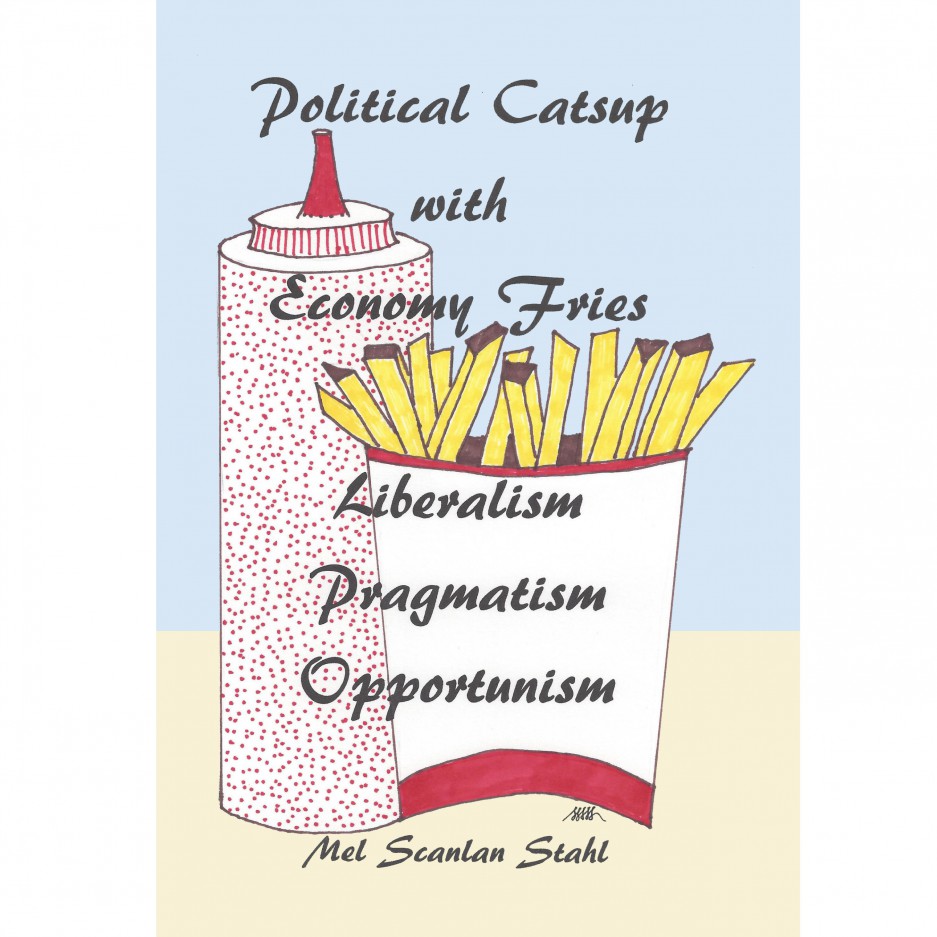
If you want to understand how Congress intervened in the U.S. economy by enacting legislation that changed our national game plan, then read Political Catsup with Economy Fries: Liberalism, Pragmatism, Opportunism available at Amazon.com right now in electronic or text format.

Discord grows as we drift away from real world narrative.

Imagination is more than extra spice in the press narrative lately.  These days imagination is the narrative.  For example, I have heard accusations in the morning news that Russians interfered with our elections but I haven’t heard any proofs.  Reporters stopped this narrative briefly after Wikileaks showed that hacking by foreign nations can be simulated by the CIA.  And Vladmir Putin has denied Russian interference.  But someone has imagined Russian election tampering and made a declaration about it.  Announcing that U.S. security agencies have become convinced of Russian interference without offering proof doesn’t convince me of anything.  It shows that imagination has become the narrative.  It may also show that news agencies have fully embraced a parody of reality in favor of “make-believe.”  That’s at least one step beyond post-modernism and a step into crazy.  Crazy can be dangerous.  So as a nation, can we take a step toward what’s real and demand proofs for security claims and in reporting?  Right now, especially, it’s wrong for blowhards to hog all the energy in politics and block potential progress.

I’ve also noticed that when Obamacare is defended, it is defended based on people’s hopes rather than on Obamacare’s performance.  People pretend that healthcare can be provided to everyone just because they want that to be true and they pretend this while the U.S. government has a twenty trillion-dollar debt.  When they describe any changes to the ACA, people speak as though there’s been a dire loss of something real that we all have been able to enjoy from Obamacare in its brief mal-implementation.  They don’t seem to acknowledge the failures of the ACA at all.  They usually don’t even acknowledge that insurance companies are abandoning the program.  Isn’t that strange?  I wish that people who want to defend the ACA would look it over more carefully and understand its shortcomings.  I have read that Barach Obama refused to provide information about the ACA despite several Freedom of Information requests.  Perhaps under the new president, that information can be supplied now.  Maybe it would encourage people to look at the facts about the ACA as it exists so they don’t overpraise it based on their fantasies about it.

I’ve noticed that the job outlook is confusing too.  I’m getting two really different jobs reports.  One uses employment agencies’ data and the other uses department of labor projections.  On the one hand, labor projections predict that jobs like data scientist, general and operations manager, information security analyst will grow and have salaries in excess of $70,000 per year.  But probably there aren’t many of these jobs in existence.  And no mention is made of job security for them.  Our labor market is shrinking for many professions right now.  On the other hand, employment agencies report job shortages for jobs that don’t pay nearly $70,000.  These are jobs like barbers, pile driver operators, tax preparers, cargo and freight agents, and skilled trade workers, for example.  Notice how projected jobs pay so well but jobs for which there’s a current shortage pay much less.  There’s an obvious difference between projections and reality.  Fantasy job projections take up space in the narratives about jobs without really offering us anything in terms of real opportunities.  It’s another example of imagination displacing reality in the narrative.

Some of our political discord comes from the conflict we all experience when facts collide with a popularized imagination based narrative.  Fantasy narratives can cause increasing political discord.  If you want to understand more about changes in policies enacted over U.S. history, specific changes that have changed the American political landscape, read Political Catsup with Economy Fries available at Amazon.com, right now.

Counterparties needed!

Every market transaction requires both a buyer and a seller.  They are called counterparties.  Unfortunately, there’s a shortage of buyers in a whole lot of marketplaces right now.  For example in home real estate.  After there were so many foreclosures during the Great Recession, home ownership fell to its lowest level in the last fifty years.  Investors started to buy up homes.  They increased the market price of home real estate by doing that and blew another home real estate bubble.  The trouble is that there aren’t counterparties who can buy homes at these inflated prices.  Foreclosures wiped out the real estate investment monies of previous buyers and real estate inflation has hampered real estate market recovery for new buyers.   Taxes on home real estate went up and that helped cities to pay for their city services (and vexed homeowners).  But finding a buyer for your home when you are ready to sell isn’t easy right now.  There’s a shortage of counterparties that can take your place as a resident home owner.

Another example of counterparty shortage is the car market.  While the average car in the United States continues to advance in age, a sub-prime car market has been nurtured.  A lot of cars have been sold to people who can’t afford a new car and these sub-prime buyers have begun to default on their payments, keeping the repo man busy.  If they try to sell their car to get rid of those payments, there’s a shortage of buyers.  The job market has had few good-paying jobs, and the economy just isn’t robust enough to cycle much money into the car market.

Another counterparty shortage example is on Wall Street.  A lot of corporations have kept their stock price elevated by buying back their own shares.  This isn’t the way that Wall Street used to work.  Wall Street was once a place where a new company could get established and then grow by selling shares to stock holders.  Then later, after much success, the company could sell itself to a buyer.  There were lots of counterparties on the way to greater success and that worked to allow profitable businesses to grow and then to be sold off at a profit.  Not so much now.  The stock market has gotten thinner and there are fewer IPO’s, now.  But worst of all, the market isn’t robust enough to sustain the growth of new companies.

A shortage of counterparties shows us that the economy we’re living in isn’t a virtuous one.  In a virtuous economy, money circulates robustly among many buyers and sellers and prosperity is more widespread.  Several steps will be required to restore our economy to prosperity.  One is to re-regulate banks and reduce their size.  Another is to reform our monetary system with sounder money which will put us on the road of ending fiscal overspending by the government.  To understand more about how we got here, to understand more about fiscal policies, monetary policies, financialization and the Sub-prime Mortgage Crisis, read Political Catsup with Economy Fries available at Amazon.com.

On the wrong road? Turn around.

There’s a saying that goes like this: “No matter how far you’ve gone down the wrong road…turn around.”

Neoliberals are the worst at admitting when they’ve caused harm with their policies.  Neoliberal policies have put us on the wrong road.  It’s a road that doesn’t lead to prosperity.  But they won’t turn around.  So, we live in the neoliberal age of denial right now.  Government sponsored corporatism is rife with economic interventionism.

Interventionism is regulations, taxes and subsidies that provide advantages to some economic players but not to others.  Neoliberal interventionism has harmed our grassroots economy partly because of supporting (with tax incentives) the pursuit of short-term corporate profits in transnational companies that obtain cheaper labor abroad.  Our market economy consists of jobs and workers who produce products and services that can be sold.  It’s terrible when a person who wants to work can’t find a job.  A lack of work can cause harms that spread everywhere.  Because no one can buy much unless they do so with debt.  There’s burgeoning debt in student loans, for example, but little opportunity to pay off those loans in a bad job market.  Even when loan requirements are lower and interest rates are lower, people can’t get by without a good job.

When corporations outsourced labor in order to benefit from cheaper worker wages, they caused many Americans to lose their job.  So many jobless people made statistics about employment look terrible.  So the government stopped counting people who stopped looking for a job (when they couldn’t find one).  President Obama ignored those working age people without a job for the sake of economic braggadocio.  But changing the way that unemployment is measured to make unemployment look less awful doesn’t fix the problem of slack in our worker populations.

With so many now unproductive and displaced workers the need for welfare increased and the need for medicaid also increased.  But the ACA didn’t really help with healthcare inflation even though it increased the amount of charity healthcare paid at ever increasing prices (which caused even more healthcare inflation).  And the performance of the ACA was so bad that insurance companies started abandoning it.  And anyone who could avoid it did so.

Bank deregulation also has harmed our economy.  It may still doom us.  There are many examples of economic harm caused by banking deregulation.  Repeal of the Glass Steagall provision, for instance, set up the opportunity for default contagion in the case of bank failure.  Alan Greenspan, the former head of the Federal Reserve, promised that he would help banks if they defaulted and that encouraged more riskiness and innovation in finance.  Cheaper loans obtained at lower interest rates under Federal Reserve policy, fed the hostile takeover epidemic during the 1990’s.  That further damaged American enterprises.  Many businesses shut down, further displacing people from their former jobs.

The subprime mortgage crisis started by ramping up home prices under false appraisals, and made use of securitized loans that moved the risk away from bankers and externalized it to others in the stock market.  After the real estate market crashed, it failed to recover.  So it can’t lead us out of economic stagnation as it has during previous recessions.  The U.S. now has the lowest home ownership in the last fifty years.  And that caused more suffering as many people lost their home investment and became homeless.  But TARP and QE haven’t returned us to prosperity.  Our economy has courted risk and shunned production.  And that leads to more workers who can’t find jobs.  Even today, the banking system is mostly unregulated and continues to seek the most risk while it externalizes its losses to the grassroots.

With twenty trillion dollars of government debt, the idea that our government should continue to intervene in the economy is ludicrous.  Why continue to do what isn’t working?  The neoliberal road is the road to ruin.  It’s time to get off that road.

If you’d like to learn how neoliberalism got going after WWII, buy a copy of Political Catsup with Economy Fries available at Amazon.com today.


Trains show why “single payer” government healthcare won’t work.

Trains were the first large-scale industry in the United States.  And it was an enormous challenge to get railroads built.  The government got involved in the rail industry by means of transportation regulations and land grants which gave large pieces of land to the railroads that could be sold for a profit or used to build track.  Trains were profitable at first because they offered a much cheaper alternative to overland transport when marketable goods were moved from place to place.  Passenger fares were less profitable than commercial fares.

When trains raised the rates that passengers were paying, the government stepped in to regulate the fares.  After years of transportation regulations, trains were less profitable.    Like the railroads, the interstate highway system was built with government investments from tax dollars.  Both of the American transportation systems, rail and highway, were aided with government money. When the interstate highway system was built, trains met with new transportation competition. And increasing competition between two government subsidized industries didn’t help the railroads.

If you study the effect of regulated train fares what you find is that the public seems to win for only a short time because they get cheaper fares.  But their taxes eventually have to supplement the money that the passengers aren’t paying.  So there’s no real savings.  Public taxation subsidizes train fares (which externalizes costs to non-users).  What also happens is that government regulation of train fares undermines the train industry until it stops being profitable.  When the government remains involved, the trains lose their ability to manage and run their business until it becomes less well maintained, less well-managed and unable to improve.

I read and hear people commenting about healthcare.  Some of them wishfully think that a single payer system will get rid of the insurance middleman and make healthcare more affordable.  But the healthcare system is already showing huge inflation that has been caused by government programs like Medicare and Medicaid.  In fact, government interference in the healthcare marketplace started during the Great Depression.  In 1933, FDR wrote government sponsored healthcare into his social security bill.  The 1933 AMA opposed this move as government sponsored healthcare, so that version of it didn’t pass into law at that time.  But soon thereafter, insurance companies like Blue Cross got started selling health insurance under hospital sponsored plans.  And nowadays, health insurance co-pays hide the very high rate of inflation in pharmaceuticals and the costs of healthcare generally.

With 20 trillion dollars of government debt, the idea that more government interference in healthcare will reduce prices is only a wish.  There’s no historical reason to believe it would happen.  If you look at railroads, government involvement destroyed a once profitable industry which had to receive government subsidies in order to run at reduced fares.  That was taxes paying what the trains couldn’t charge customers according to regulations.  Government was powerful but it couldn’t use its power to change the nature of the train business.  Lower fares weren’t enough to keep the railroads healthy.  And the railroad industry became less nimble and less robust.  Some would say that it wasn’t even a real industry anymore–just a hollowed out shell of its former self.  Eventually the government had to buy it.

The healthcare industry is larger and more complicated than the railroad industry.  Government interference in healthcare has already raised prices and encouraged monopoly.  Single payer would further harm or even destroy the healthcare marketplace and it would serve interests outside of caring for sick people.  Government intervention in the healthcare marketplace has already harmed both doctors and patients.  “Single payer” isn’t any kind of remedy to our healthcare problems.  It would only worsen harms to patients and doctors.

If you would like to learn more about how we got to our current place in history, buy a copy of Political Catsup with Economy Fries available at Amazon.com today.

sources:

Wikipedia, History of Health Care Reform in the United States, https://en.wikipedia.org/wiki/History_of_health_care_reform_in_the_United_States, accessed 20 Mar 2017.

R. Kent Weaver, The Politics of Industrial Change: Railway Policy in North America, The Brookings Institution, Washington D.C., 1985.

A well deserved death.

What if the idea of a national healthcare program is flawed because we can’t afford it under current economic conditions?  Setting aside the twenty trillion dollars of government debt for a moment, consider just the question of a patient’s payments.  What if there’s (1) no way to tax the people (over there) in the shrinking middle class living with less money every year to (2) pay for the poorest people (over here) who can’t afford to pay for the inflated price of healthcare in order to (3) make a huge profit for insurance companies everywhere and (4) make a huge profit for pharmaceuticals and (5) create inflation in the economy that disguises poor GDP performance?

What if that government sponsored healthcare model can no longer be sustained and that’s why Obamacare is failing and why it must fail?  Of course, it may also be failing just because it was a bad product that served as (1) a vehicle to inflate healthcare costs while (2) offering less care, and (3) less healthcare security and (4) virtually no privacy or information security.  One example of healthcare inflation is the cost of Novolog insulin.  It has gone up in price over the last five years by 248% (see note below)!  No one in the pharmaceutical industry can explain why this product should cost diabetics ever more money in our shrinking economy.  Why does it cost so much?

Part of our problems with healthcare begin with regulatory politics.  When you look at the regulations that came about during the modern liberal era from 1861-1944, there were a lot of regulations designed to prevent harms.  For example, regulations in the Food and Drug Administration established in 1906.  When a business failed to respect regulations designed to keep the public safe, it could be sued in civil court for monetary compensation.  A contrast can be seen by comparing the modern liberal and classical liberal period.  During the classical liberal era, which happened from 1776-1861, instead of trying to prevent harms through the growth of the regulatory state, courts allowed parties who were harmed to seek damage claims in criminal court and sometimes the court would revoke the operating licenses of businesses that caused harms.  During the neoliberal period from 1944-the present, damages have been pursued in civil court and large sums have sometimes been awarded.  In healthcare, that has increased costs by adding fees that doctors now pay for malpractice insurance.  And also now, doctors are ordering unnecessary testing just to avoid a malpractice claim under standards of care that create more billable tests.  That increases costs, too.

What if the Trump Administration isn’t able to revamp and reinstall the government’s involvement in healthcare?  Because it doesn’t work.  Healthcare inflation was always expected as a side effect of government healthcare programs.  And now we see that healthcare inflation has gone cost-crazy.  What if the government stopped guaranteed payment of pharmaceuticals at a constantly inflating price?  Wouldn’t the price come down?  What if the insurance middleman went away?  Wouldn’t that reduce costs?  What if people acted as their own agent in paying for healthcare and choosing their doctor?  What if this allowed them to re-energize their patient doctor relationship?  Instead of being at the mercy of insurance providers and doctors that don’t care about patients anymore?  Wouldn’t that decrease costs by increasing competition among doctors for patients?  What if the number of billable tests went down instead of increasing?  Wouldn’t that decrease costs?  What if bad doctors were removed from practice and the need for malpractice insurance went down?  Wouldn’t that decrease costs?  What if the government’s involvement in healthcare has been a terrible economic mistake that is now destroying the healthcare marketplace?  What if?

I realize that our media keeps banging the drum for “replacement” and not just for “repeal.”  In fact the very idea that fundamental changes are needed in healthcare is strictly avoided by the media which proposes that the U.S. government should continue to interfere with American healthcare, despite the obvious failure of Obamacare.  Media outlets that say we need to “replace” Obamacare are really saying, “we need government sponsored healthcare.”  Even though most Americans didn’t sign up for the healthcare exchanges.  Because they didn’t want Obamacare.  And I think that many Americans who have wanted Republicans to repeal the Affordable Care Act didn’t want to replace it.  They saw that the government’s involvement in American healthcare was bad.  It invades privacy because it allows government encroachment into people’s private health concerns.  It also invades privacy because computers are vulnerable to computer espionage.  Because we are mortal, government healthcare makes us vulnerable to healthcare denial and inflation.  Ouch!  Those are two harms we want to avoid.  Perhaps instead of replacing the ACA, it should just be allowed to die the death that it deserves.

Note:   It may be hard to imagine a 248% increase but that means that if a vial of insulin cost $113.59 five years ago, it now costs $281.72!  (A diabetic uses many vials per year.)  The same runaway inflation is happening in other medicines too.  Insurance companies, pharmacy companies and the subsidized and protected medical profession needs Obamacare and medical insurance programs in order to ramp up medical costs this dramatically.  Co-pays hide the real costs.  A real market wouldn’t hide these price increases and the public wouldn’t tolerate them.

For source material on date, see: US Food and Drug Administration, https://www.fda.gov/AboutFDA/WhatWeDo/History/, accessed 13 Mar 2017.

Would you like to understand how our laws have changed since the founding of the nation?  Would you like to understand what has motivated those changes?  If you want answers to those questions and more buy a copy of Political Catsup with Economy Fries: Liberalism, Pragmatism, Opportunism, available at Amazon.com.

Thomas Sowell wrote about market economies.

According to Thomas Sowell in his book Basic Economics, markets operate according to profits and losses.  The profits tell producers what to produce and the losses tell them what to stop producing.  When market forces are working, producers respond to what people need and want and also to what they can afford.  That makes the market responsive to society.  But under neoliberalism, economic interventionism creates a different less responsive marketplace.  Instead of responding to people want, need and can afford, the market produces more of what the government provides subsidies for.  Subsidies can be tax reprieves, for example.  Or, instead of a subsidy, a low-interest loan can allow a corporation that isn’t profitable to continue making what no one wants, what no one needs, and what no one can afford.  Another word for making things that no one wants, what no one needs and what no one can afford is “malinvestment,” and malinvestments waste economic resources and cause society to suffer.  Sowell writes, “Profits as a realized end-result are crucial to the individual business, but it is the prospect of profits–and the threat of losses–that is crucial to the functioning of the economy as a whole.”  And of course he’s right about that.

Something to ponder today, if you’re in the mood to ponder the economy, is whether low-interest loans and tax subsidies and imported cheaper labor serve the public’s interest in terms of keeping the market healthy.  Is the market providing what people want at a price that they can afford?  How much malinvestment surrounds us?  And since the market clearly isn’t healthy and hasn’t been healthy now for a while, maybe we can see a failure of economic interventionism and a failure of neoliberalism.  (A failure of TARP, a failure of QE, a failure of the ACA, a failure of Obama’s economic stimulus programs, a failure of wars in the Middle East, nearly 95 million working age people who aren’t working because the neoliberal economy is so bad that there isn’t enough prosperity in it to provide employment opportunities to those people).

The Commerce Clause in the U.S. Constitution was interpreted differently during the modern liberal period from 1861 to 1944.  Congress’s power expanded under the Commerce Clause to help the nation make the most of new markets that formed during railroad transportation improvements.  Article One, Section Eight is a long list of Congressional powers.  The Commerce Clause reads, “The Congress shall have Power To regulate Commerce with foreign Nations, and among the several States; and with the Indian tribes;”.  As the economy continues to lack prosperity, I hope that Congress will stop using the Commerce Clause for economic interventionism.  I hope that Congress will count the terrible costliness of their harmful interventions.  Because they have interfered enough to destroy the market mechanism of market self-regulation.  Not only have they interfered with the self-regulation of markets, they have stimulated the growth of monopolies across the nation.  In doing so they haven’t added to their influence but instead have undermined the U.S. economy and prosperity.

If you want to read more about how Americans have navigated challenging economic times over our history and through three different political ideologies, then buy a copy of Political Catsup with Economy Fries at Amazon.com today.

The quote came from:

Thomas Sowell, Basic Economics, Third Edition, (Basic Books, A Member of the Perseus Books Group, NY, 2007), 173.


Triple whammy!

I wonder how many more times I will read about globalization and discover once again that globalization is misrepresented.  Let me clarify twenty-first century globalization for you.  First of all, twenty-first century globalization comes with neoliberalism and financialization.  They are a triple threat to prosperity for most of the world’s people.  The combination of globalization, financialization and neoliberalism is why this 21st century version of globalization is so harmful.  Also, globalization isn’t new.  Even in the classical liberal past, from 1776 until 1861, well-to-do people in portraits wore finery imported from around the world.  Similarly, globalization was part of the modern liberal period, from 1861 until 1944.  As global populations grew, globalization grew.  Globalization sharpened competition for raw materials to use in industrial processes.  Nations competed for those raw materials until WWI and WWII broke out.  Now in the neoliberal period, mobile capital through international banking gives the largest capital holders financial advantages over people and groups that have less capital.  And that financial advantage becomes power over markets and even over nations.  And neoliberalism, or state sponsored corporatism, makes it all possible.

If you want to learn more about how we find ourselves in a lackluster economy with economic and political insecurity buy a copy of Political Catsup with Economy Fries available at Amazon.com.  I take you step by step through the political and economic changes that bring us to the present.

Welcome to the neoliberal age.

There’s no reason for you or anyone else to be surprised by the neoliberal age now in 2017.  Neoliberalism got started after WWII and it’s been ongoing since then.  If you aren’t aware of it by now, you haven’t been paying attention.  Neoliberalism is government sponsored corporatism.  It is the modus operandi that explains why the TPP was being written in closed sessions during the Obama Administration.  And it was being written by corporate entities and their lawyers seeking to protect various vested interests by writing the treaty.  When the public realized what NAFTA had done and decided that the TPP was worse, many of them wrote their Congress members to oppose its passage.  They broke through from indifference to an understanding that saying “no” to the TPP was essential to protecting their access to opportunities that would be lost to them if it was passed.  And Congress listened.  And President Trump also listened.

Neoliberalism also explains why insurance companies played such a large role in drafting the ACA during President Obama’s Administration.  It was supposed to make a lot of money for insurance companies until most people in the public turned their backs on it.  Even without clear reporting about the ACA (several Freedom of Information requests were ignored by the Obama Administration) the public realized that the ACA wasn’t a viable plan for the nation’s healthcare.  Most of the ACA sign ups were accomplished through the welfare bureaucracy to bring in people on Medicaid.  Writing legislation with corporate interests in mind has been going on for a long time.  It is the way Washington does its political dance now in 2017.

I was reading a recent criticism that President Trump has too many corporate players involved in government as though that should be surprising.  But corporations and governments have been dancing together since 1944.  Why act surprised about that?  Government started thinking of corporate welfare as more important than individual welfare starting in 1944.  After 1944, laws were gradually changed in the United States to support corporate interests, starting with tax laws.  If you wish to change our government and reactivate the government’s interest in your welfare, then pay attention to policies being argued over in Washington D.C..   Understand that you should look carefully at new legislation because it may affect your interests.  There isn’t a professional class of bureaucrats and elected officials that you can rely upon to look out for you except when you remind them what you want them to do.  Don’t expect them to automatically work on your behalf when corporations have played such a large role in motivating our government’s policies since 1944.

I don’t know if President Trump will be able to change policies to bring jobs back to the jobless, or revoke the ACA in a time of healthcare racketeering, or rebalance international trade agreements to improve the American economy, or re-mobilize and reorganize our military to decrease its empire role and refocus it as a capable defensive force to protect us here at home.  But whatever he does, he is doing in the neoliberal age.  So there’s no need to act surprised about that.  And when various people step forward and speak about politics, you should be aware that it may not be your interests that they keep close to their hearts.  Your interests may not concern them at all.  Finally, both the Democrats and the Republicans are completely loyal to neoliberal politics.  You can tell that’s true if you look at how your share of the political and economic pie keeps shrinking.  It’s up to you to speak up and reject more interference from them in your interests.  Because neoliberals will put you and your interests last as often as you let them.

If you want to increase your awareness of the neoliberal age, then buy a copy of Political Catsup with Economy Fries available at Amazon.com.  I explain neoliberalism’s origins, timing and how it grew to become so influential. I identify the people who brought in neoliberal ideas in economics and how neoliberalism affected American politics.

Walter Lippmann warned us in The Good Society.

The Good Society was originally published by Little Brown and Company in 1937.  In it, Walter Lippmann argued that modern liberalism is better than communism or fascism.  Modern liberalism was the dominant American political ideology from after the American Civil War until World War II ended.  Lippmann tried to make modern liberalism, a mild form of socialism, seem like a modern political approach that was unlike other forms of collectivism.  He imagined that American courts could protect Americans from the problems faced in other collectivist societies.  The Good Society may be the best book to explain American modern liberalism.  But it also can help us to understand what has happened after modern liberalism was replaced by neoliberalism.  Here’s a quote from The Good Society that I think describes today’s neoliberal problems that arise when governments operate under the goal of limitless power.

“The predominant teachings of this age are that there are no limits to man’s capacity to govern others and that, therefore, no limitations ought to be imposed upon government.  The older faith, born of long ages of suffering under man’s dominion over man, was that the exercise of unlimited power by men with limited minds and self-regarding prejudices is soon oppressive, reactionary, and corrupt.  The older faith taught that the very condition of progress was the limitation of power to the capacity and virtue of rulers…All the wishing in the world, all the promises based on the assumption that there are available omniscient and loving autocrats, will not call into being men who can plan a future which they are unable to imagine, who can manage a civilization which they are unable to understand.”

To summarize Walter Lippmann, he’s saying that granting more power to our government won’t make government bureaucrats and elected officials smarter or more able than they would be without such terrible power.  Giving them more power doesn’t mean that they will accomplish more.  Americans should keep this in mind when they want our government to tax (others) more and do more (for their friends or themselves).  With twenty trillion dollars of debt, our government can’t do whatever people imagine it can do for them.  Twenty trillion dollars in the hole and an economy that still hasn’t recovered since the Great Recession is a lot of failure.

Wish fulfillment isn’t what a government does, anyway.  And that is especially true with twenty trillion dollars of debt.  I have been puzzled to hear political proposals for free tuition and free healthcare.  We can see that neither goal has been realized.  Warfare in the Middle East can’t continue either.  Neoliberals have tried to externalize corporate and government spending to ordinary Americans.  They risk capital in risky ventures backed up by tax payer dollars (remember the sub-prime mortgage crisis: unqualified borrowers, debt default, tax money instead of bank failure).   Such mal-investment wastes society’s resources as much as war and failed government programs do.  In fact, by imagining endless power by printing more money (a policy that has failed with horrible results many times over history), American political and economic policies have veered off from trying to accomplish what’s possible to striving for what’s impossible.  Just look at the mess that our policies are causing.

Most people understand that “there’s no sense crying over spilled milk.”  That after the milk has spilled it has gone to waste.  Most people understand that a person’s opportunity can be wasted or an investment that hasn’t paid off has been wasted.  And after it’s wasted, its value isn’t still obtainable.  When our economy isn’t working well to build prosperity, money that a healthy economy might have created isn’t hiding somewhere, it’s gone.  When you consider how many working age people aren’t employed in the U.S., that represents a waste.  Isn’t it time to change what’s not working?

Walter Lippmann, The Good Society, Transaction Publishers, New Brunswick, New Jersey, USA, 2005, 40-41.

If you want to read more about Walter Lippmann, he is featured in Political Catsup with Economy Fries, which will bring you up to speed on American political ideologies and their everyday resonances in today’s politics.  Just go to Amazon.com and order your copy today.