A chance for bank reform.

Janet Yellen’s term as head of the Federal Reserve Board will soon end and President Trump will select a new leader.  There are six other Federal Reserve Board positions that President Trump may have an opportunity to appoint, according to an article by John Mauldin writing for Forbes.  Mauldin seems to think that Trump would prefer a less dovish Fed.  I would wish for a bigger change than that.

Bank deregulation got going during the Carter Administration and continued until Glass Steagall was repealed during the Clinton Era.  Deregulation has led to innovations like derivatives and financialization that benefit large capital holders.  Meanwhile the rest of the economy continues to decline in prosperity.  Many small businesses have gone under.  Hopelessness abounds and is shown by the opioid crisis and mass shootings.

I would like President Trump to shrink the size of banks.  He should also increase their solvency by requiring them to hold more capital in reserve.  Since the Greenspan Put, the Federal Reserve has promised to shore up banks with tax payer monies in the case of a collapse like the Sub Prime Mortgage Crisis.   Greenspan’s promise became a subsidy for bank failure and it should end.  Glass Steagall was part of the FDIC era and separation of investment banking and commercial banking was another crucial part of it.  According to Dodd Frank, Americans savings can now be used to bail in failing banks (those Americans would lose their savings).  So much for FDIC insurance.  Glass Steagall should be reinstated with meaningful depositor insurance.

The amount of uncertainty that all Americans now are exposed to continues to harm everyday people.  Ninety five million people are out of work in the U.S..  Isn’t it time to realize that deregulation in most areas of our economy has created new harms?  Isn’t it time to stop white-collar fraud in banking and money laundering?  Isn’t it time to stop monopoly banking and Too Big to Fail Banks?  Isn’t it time to use new appointments on the Federal Reserve Board to institute widespread banking regulatory changes that would recapture economic opportunities for more Americans that hold small amounts of capital that they use to raise their families and prepare for retirement?

I heard someone on the radio blaming Americans for the state of the nation.  He thought that people who don’t care about political outcomes cause bad outcomes.  But most Americans aren’t charged with oversight of American Banking the way that the federal government is.  Because of that, I don’t blame everyday people for our economic woes.  I blame Congress’s penchant for deregulation.  I’m calling for a change of seas in federal banking regulation that would restore security to American banking.

If you’d like to learn about neoliberalism and how it affects American politics today including the state of our economy, buy a copy of Political Catsup with Economy Fries at Amazon.com.  It will explain our banking woes and the nature of derivatives and financialization.  Those are essential topics for all Americans.

sources:

John Mauldin, “Trump Could Get Seven Appointments to the Fed,” Forbes, Dec 22, 2016,  http://www.forbes.com/sites/johnmauldin/2016/12/22/trump-could-get-seven-appointments-to-the-fed/#29cc79f339d7, accessed 8 Nov 2017.

Anat Admati and Martin Hellwig, The Bankers New Clothes: What’s Wrong with Banking and What to Do About It,” Princeton University Press, New Jersey, 2013.

We are haunted by the ghosted economy.

Here we are.  The day before Halloween.  And Congress has played us a few tricks.  The ACA hasn’t provided better care even though it has vastly increased healthcare insurance costs across the nation.  It served to signal Congressional concern for the nation’s health.  And political rhetoric opposing the repeal of the ACA continues to harp on about how much Congress cares.  But instead of improving our healthcare opportunities, the ACA has been a way to centralize healthcare operations which has created more healthcare monopoly.  It has also increased taxes.  It has decreased the availability of doctors who are leaving medicine altogether and increased the cost of people’s doctor visits by encouraging more billable testing without helping people to have better health outcomes.  Costs for health insurance and pharmaceuticals have continued to rise.  People’s average life expectancy is falling across the United States.  When the housing bubble happened, after the Federal Reserve and Congress removed Glass Steagall regulatory protections, a lot of people lost their mortgage investment as they were turned out of their homes.  The cost of health insurance is now about the same as the cost that a mortgage used to be.  In fact this high healthcare cost is keeping people out of housing.  I call that a ghoulish policy outcome for the subprime mortgage crisis and the ACA.

Congress and the Federal Reserve also continue to monkey around with the monetary system and our federal budget.  How can people in Congress imagine that more than 20 trillion in debt is good for our nation?  In fact, why do they need to tax Americans at all since they never reduce government debt or government spending?  If they plan to overspend forever in these astronomical amounts, why do they need to tax us–since our taxes do no good?  Hear the wails of suffering in America and contrast them with the public’s forbearance to allow the nation’s budget malfeasance to continue.  Hear those wails and consider them with the amount of our indebtedness that continues to go without payment because Congress so often refuses to shrink federal spending.  Think of suffering moans when you hear empty political rhetoric about guaranteed wages for no work, free universal healthcare, and a free university education and ask yourself where the money to pay for those programs would come from.  It would have to come from taxpayers.  Congress isn’t benevolent and it clearly has pursued policies that diminish our nation’s prosperity.  If you look at Congress’s policies, and you look at the lack of overall prosperity, you should recognize that Congress has finagled terrible economic outcomes that are hurting almost everyone.  Reality can be more scary than Halloween fiction.  It is scarier than Dracula or Freddy Krueger or a werewolf.  Congress is the scariest of all.  Is there a ghost of a chance that our economy can improve in the short-term?

Major news agencies continue to hammer on with a barrage of nasty comments about the Trump presidency.  In fact, all news outlets have been so empty of rational or real content that I only listen now to hear whoppers that everyday convince me that there’s nothing of value in our news.  Instead of telling us something useful or interesting, news has become a way to whip up hysteria.  As economic interventionism by Congress has run its course, the market economy has continued to decline.  In history, U.S. media gained in influence after the Civil War during the age of railroads.  It was strengthened by improvements in transportation and communication that stimulated the second wave of the industrial revolution.  It was borne along and empowered by our once strong market economy.  But as our market economy has failed under the government’s fiat money system and economic interventionism, malinvestment has wasted economic resources and undermined the public’s interest in news feeds that aren’t remotely connected with “news people can use.”  Our economy is a ghost of its once vibrant self.

Zero interest rate policy undermines savers and especially elderly people who have aged out of the labor market.  Because ZIRP has gone on so long and because the ACA provides a way to support elderly people who need care but who can no longer pay for their care, I think that the combination of ZIRP and the ACA are another ghoulish policy combination.  They suck the remaining life out of the financial assets of old Americans and show us the lengths to which our government will go to take away assets and money from people who can’t defend themselves from government maladaptations and government malfeasance.  Growing poverty and helplessness among the American elderly are another policy outcome that will continue to haunt us.

If you want to learn more about how Neoliberalism came to prominence and influence in the United States, read Political Catsup with Economy Fries at Amazon.com.

Neoliberal regulatory capture leads to mass shootings.

There weren’t any school shootings when I went to elementary, middle school and high school.  Nobody’s kid shot up their school.  And school suicide rates were a lot lower then.  I was thinking about that and I remembered that when I went to school, kids weren’t medicated like they are being medicated now.  A lot of today’s kids are now put on ritalin and antidepressants.  Can these drugs cause some kids to become violent?  Can they encourage suicide in some?

An article that I pulled from the internet over the weekend, “New Study Confirms What CCHR Has Said for Decades–Antidepressants Cause Violence,” cited several sources that make the claim “that antidepressants can cause violent behavior.”(1)  PLOS Medicine  found that “young adults between the ages of 15-24, were nearly fifty percent more likely to be convicted of a homicide, assault, robbery, arson, kidnapping, sexual offense, or other violent crime when taking the antidepressant than when they weren’t taking the psychiatric drug.”  I mention this age group because my community recently had a school shooting that resulted in a fatality.  It happened just a few weeks ago.  Many people were eager to blame the shooter, but what if he brought those guns to school because he was under the influence of a psychoactive drug?  What if it wasn’t his fault?  What if the fault for this mishap doesn’t belong to him at all?

According to a Wikipedia article (2) that I read over the weekend, “Development and Discovery of SSRI Drugs,” SSRI’s “are recommended by the National Institute of Health and Clinical Excellence (NICE) as a first-line treatment of depression.” and yet Kirstie Alley, the actress famed for her role on “Cheers,” tweeted on Oct 2nd, 2017, that one additional common denominator of “shooters” is psychiatric drugs that have side effects including violence and suicide.  And I think that she meant that those side effects would be found among many age groups, not just among people between 15-24 years of age.  She was, of course, referring to the recent shooting in Las Vegas on the first of October (3).

Many pointless questions and comments are being made about mass shootings and many of them refer either to the guilty mind of the perpetrator or gun rights that American citizens enjoy.  I think that exploring these topics will not help us to stop the problem of mass shootings in America no matter how much we talk about them.  Instead we should focus on pharmaceuticals, their side effects and the profits that pharmaceutical companies are making from psychoactive drugs.  We should notice that mass shootings might be the consequence to society of trying to medicate America into a better state of mind.

We can already see how the profit motive has affected the sale of opiates in the United States.  Many Americans are now dying of opiate addiction and overdose.  But opiates aren’t the only drug that’s being sold for profit instead of to benefit the people for whom it is prescribed.  Antidepressants may be a similar example where large profits have led to a reckless number of unnecessary and harmful prescriptions.  And we should realize further (in the case of antidepressants) that we are observing the externalization of risk to all of us (by exposing us to shooters that are obsessed with violence because of antidepressants) for the sake of making huge amounts of money in the sale of antidepressants by pharmaceutical companies.  According to an article, “Mother’s Little Anti-Psychotic Is Worth $6.9 Billion A Year,” (4) Abilify made almost $6.9 billion dollars for Otsuka America between 2013-2014.  That’s only one of the many drugs that are available from a variety of drug manufacturers.

According to an article titled, “Antidepressants Are A Prescription For Mass Shootings,” there’s now a FDA black box warning for all antidepressants that states “there is an increased risk of suicidal thoughts and behavior by taking the drug.”  Does this warning go far enough?  What if mass shooters are being medicated into violence?  The warning doesn’t say that an antidepressant can make you buy 27 guns and thousands of rounds of ammunition.  It doesn’t say that you might kill a lot of people who you know or don’t know.  According to Dr Peter Breggin, a psychiatrist, “depression rarely leads to violence and it’s only since the SSRI’s came on the market that… mass shootings have taken place.” (5)  The article lists some famous mass shooters and links them with antidepressants.

Regulatory capture happens when perverse incentives encourage regulatory companies to ignore the risk and harm that they are supposed to prevent by stopping the sale of something that can cause harm.  Regulatory capture is happening when NICE makes risky drugs the first line of defense against depression.  Joseph Stieglitz said that “neoliberalism privatizes the profits and socializes the losses,” by externalizing consequences to the public.  Here the terrible consequences are to both young and old Americans that are caught up in pointless violence that has likely been caused by a prescription.  Instead of blaming perpetrators, who take these drugs on the advice of their psychiatrist, it’s time to look at where the money went when the risk was externalized to all of us.

Isn’t it time to pull back on the number of new antidepressant prescriptions?  And isn’t it time for a moratorium on SSRI prescription to people between the age of 15-24?  According to the Wikipedia article mentioned above, withdrawal from anti-depressants has to be gradual and careful, but weaning Big Pharma off the flow of money may be even harder than tapering some patients off antidepressants.

If you would like to learn more about neoliberalism, its political goals and effects on society, read Political Catsup with Economy Fries; copies available on Amazon.com.

Sources:

(1) Patricia O’Meara, “New Study Confirms What CCHR Has Said for Decades–Antidepressants Cause Violence,” September 22, 2015, http://www.cchrint.org/2015/09/22/new-study-confirs-cchr-antidepressants-cause-violence/, accessed 7, Oct 2017.

(2) “Development and Discovery of SSRI Drugs,” http://www.en.wikipedia.org/wiki/Development_and_discovery_of_SSRI_drugs, accessed 7, Oct 2017.

(3) “Las Vegas Strip Shooter Prescribed Anti-Anxiety Drug in June”, https://www.reviewjournal.com/local/the-strip/las-vegas-strip-shooter-prescribed-anti-anxiety-drug-in-june, accessed 7, Oct 2017.

(4)  Jay Michaelson, “Mother’s Little Anti-Psychotic Is Worth $6.9 Billion A Year,” http://www.thedailybeast.com/mother’s-little-anti-psychotic-is-worth-dollar69-billion-a-year, 9, Nov 2014, accessed 7, Oct 2017.

(5) “Antidepressants Are a Prescription for Mass Shootings,” http://www.cchrflorida.org/antidepressants-are-a-prescription-for-mass-shootings/, accessed 7,Oct 2017.

(6) Ali Le Vere, GreenMedInfo.com, “Mass Shootings: The New Manifestation of an Ancient Phenomenon and their Link to Psychiatric Drugs,” http://Kellybroganmd.com/Author/Ali-Le-Vere-Greenmedinfo-Com/, accessed 10, Oct 2017.
Is Congress Paying Attention?

Remember school report cards under a grading system?  Teachers would give scores for tests and tally up your total and then declare your grade.  Careful students would already know their grade because they would have paid attention to what they were doing.  What is Congress doing?  Is Congress paying attention?

How do you think that they are performing as legislators?  What are the consequences of their policies?  Did Congress try to get outcomes that would create prosperity for most Americans?  Aren’t there more people on the margins of society now–people, for example, who can’t find a job?  Do you think that Congress is maybe just trying to save people at the margins from some of the economic disasters that Congress has been causing with deregulation, globalization, financialization, and greater economic centralization?  Does Congress even have a plan in mind for overall prosperity?  Some members of Congress sound like they’re telling themselves that the ACA is for saving people at the margins, but just look at the people who are not saved, and look at high inflation in healthcare.  And look at cyber-insecurity that extends to those new digitized healthcare accounts.

Congress doesn’t seem to look out for the long-term consequences of their decisions, from globalization, to financialization to war.  Lately, since so much of our economy is going digital, I’ve wondered what would happen if our satellites were destroyed or taken over by a foreign power.  Should we rely so much economically upon digital technologies?  If you were Congress’s teacher, wouldn’t you remind them that long-term outcomes matter to our society and to individuals?  Would you instruct Congress to look not just at tomorrow but at many years worth of tomorrows?

I wish that members of Congress would give their own policies a grade.  I would like them to remember what they were trying to accomplish with globalization or financialization or adopting digital technologies or many of their other big change policies that have established the “new normal”.  Then I would like Congress to evaluate their policies based on their original goals.  Did they achieve their goals?  Then they could also evaluate the unintended consequences of their policies.  Give the policy a grade.  Should Congress keep that policy or change it based on the outcomes that it has caused?

As Congress has continued practicing economic interventionism, their effectiveness as legislators has declined.  But Congress continues on a path of economic interventions.  How can we stop Congress from making even more economic mistakes?  How can we restore Congress to a more effective legislative body?  What changes are necessary?  How can we become a strong nation again based on improved economic performance and improving prosperity?  Read Political Catsup with Economy Fries to discover answers to these questions and others, available on Amazon.com.

Immigration matters to neoliberals because they use borders differently.

I grew up on the border between the United States and Mexico.  I was a minority in El Paso where Spanish speakers were the majority.  I enjoy Spanish as my second language and I like Mexican culture, including architecture, cuisine, and art.  I’m used to periodic controversies erupting from illegal immigration and I’m used to the perennial presence of migrants.  I recognise that immigrants bring labor and talent to the U.S..  But the current controversy over immigration has roots in globalism instead of erupting out of concern for immigrants as individuals.

Neoliberals use borders differently.  To a neoliberal who owns a multinational business under the juristiction of many different courts in several different nations, a border is how corporatists can escape reprisals for causing harm.  When a corporation has operations in several nations, prosecution for crimes against persons and property is hard for litigants to accomplish.  There are interstitial judicial spaces between nations that allows corporations to escape judicial prosecution.

Also, globalists strive to acquire access to a variety of international resources through the use of capital.  They can use factories in foreign nations to assemble products and they can get cheaper labor there.  Likewise, bringing immigrants to the United States allows transnational corporatists to reduce wages that they pay to those immigrants and also reduces the value of American work and workers.  In particular, American scientists and engineers have lost value for their services when foreign scientists and engineers have been brought here from abroad.  Although we periodically hear that there is a STEM shortage in the U.S., there are plenty of unemployed American scientists and engineers who continue to be replaced by foreigners who do the same job for less money.  The IT industry has abused H1-B visas in order to import cheaper computer and science workers from abroad.

Making borders less effective allows global corporatists to utilize cheaper labor and sometimes allows them to escape labor regulations because foreigners avoid bringing attention to labor issues, even when illegal practices should change.  The idea of a world without borders benefits neoliberals because it gives them greater access to the world’s resources– even to the world’s workers.  While nation states often recognize natural rights, and while nation states often have coherent laws to regulate workplace fairness and safety, neoliberals can escape the cost of safety, fairness and better pay by utilizing open borders (obtaining cheaper labor abroad in foreign nations) and evading nation-state jurisdiction (by utilizing nervous foreign workers at home, and middlemen managers abroad).  Some foreign workers that come to the U.S. are impoverished and require welfare which allows corporatists to pay them even less.  Neoliberals are happy to externalize the costs of foreign workers.

If you would like to learn more about neoliberalism, buy a copy of Political Catsup with Economy Fries, available at Amazon.com.


America’s monuments are part of our history.

Neoliberals want to destroy American history by destroying our monuments that tell the story of our past.  These monuments have little to do with venerating slavery.  On the contrary, they speak to us about people who were alive when we changed from a slave nation to a free one.  That was a costly decision.  And although Americans continue to suffer from the legacy of slavery, destroying the past isn’t in our better interests.

I realize that some people want to cast our economic problems as being against certain groups.  Identity politics frames our political troubles in that way.  But it should be obvious to all of us that many Americans in many groups suffer in this terrible economy that reduces opportunities for most Americans.  I would like our political leaders to address the economy’s problems instead of destroying our Civil War monuments that commemorate our courageous past.  Both sides fought for what they wanted and slavery lost.  The Civil War led to a lot of suffering and then much later to days of greater social equity and greater economic opportunities.  If you want to learn more about neoliberalism and how we got to our political and economic present-day, read Political Catsup with Economy Fries, available at Amazon.com.

Six natural rights Americans have in the United States.

Randy E. Barnett (b.1952), in his book Restoring the Lost Constitution: The Presumption of Liberty, wrote that to early Americans, natural rights were liberty rights.  He wrote that “natural rights are the set of concepts that define the moral space within which persons must be free to make their own choices and live their own lives if they are to pursue happiness while living in society with others.”

He identified six basic natural rights: the right to worship according to conscience, the right to speech, the right to emigrate, the right to self-defense and property ownership, the right to alter or abolish an unjust government and the right to assemble.

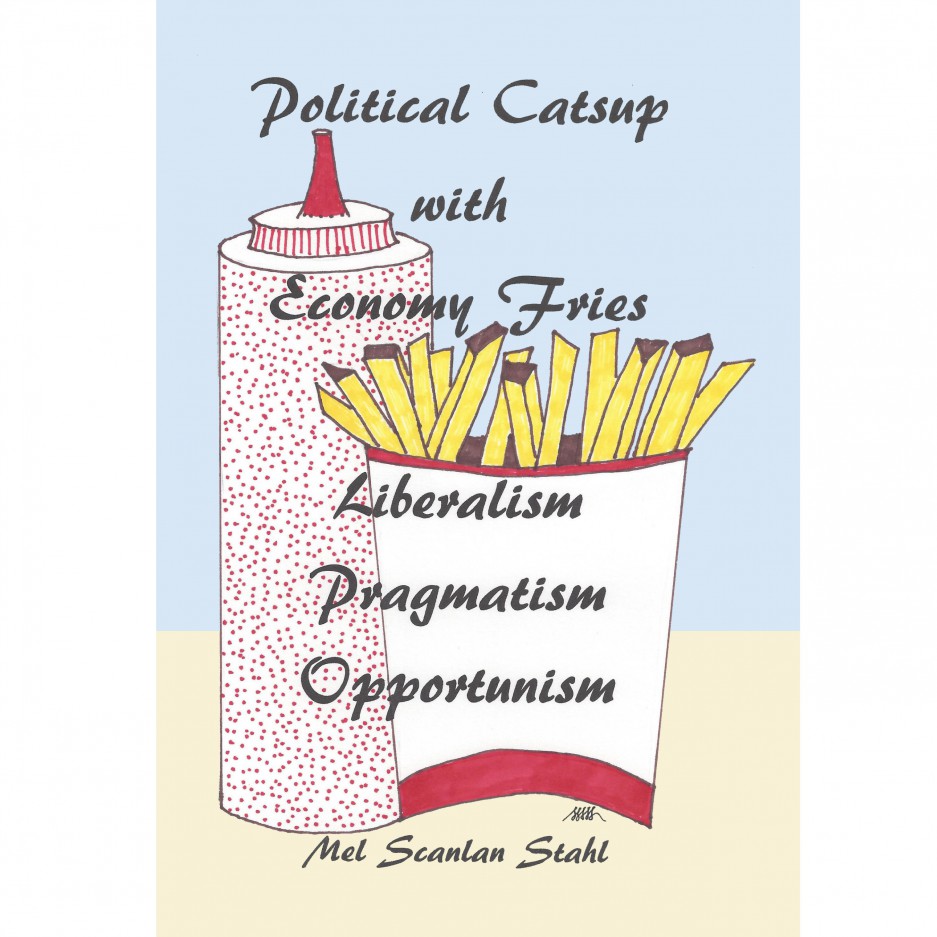
All Americans have these rights despite intolerance demonstrated in the press.  These rights are based upon moral principles that founded our country.  They are American rights.  As natural rights, these ideas offer freedom and liberty to any nation that embraces them.  To read more about American history and the sequence of political ideologies that have influenced American politics, get a copy of Political Catsup with Economy Fries: Liberalism, Pragmatism, Opportunism, available at Amazon.com.

A better world…

Do you find this to be a better world?  Is it better with a more centralized economy where corporations and government try and fail to control outcomes?  Is it a better world where a job can be obtained only by meeting the requirements of an algorithm (40% of applicants are excluded right now)?  Is it better to have fewer health care options (as the ACA whittles away at your disposable income through increased taxes for decreased care)?  Is it better to try to get a job online (where you may never know why you can’t get hired)?  Is it better to pay double for anything you need like a house or a prescription or an education, or a car even though inflation is listed as below 3%?  Is it better with almost no interest on your savings and high interest on your debt?  After longterm war in the Middle East is it better now to watch the federal government shop for a new war in North Korea or Moscow?  Is this better?

If you see neoliberalism as a failed experiment that harms your interests, but you don’t understand how we find ourselves living this way, buy a copy of Political Catsup with Economy Fries: Liberalism, Pragmatism, Opportunism at Amazon.com., and learn about the three political ideologies that have influenced our U.S. history.

All neoliberalism, all the time.

I just saw a two-part interview on Tavis Smiley’s show where Naomi Klein talked about her new book, No Is Not Enough: Resisting the New Shock Politics.  Naomi Klein spoke about resisting neoliberal politics (though she used President Trump as the source of bad politics and didn’t use the word “neoliberalism”).  Klein abandoned an honest portrayal of neoliberal politics from the point that she adopted this position that Trump is the source of America’s political problems as though our problems are being caused by a personality instead of an ideology.  That’s especially true because Naomi Klein also wrote The Shock Doctrine, which dealt more directly with neoliberalism as an ideology.

Klein sees President Trump as someone who would institute policies that would harm minorities, women, and the poor and benefit corporations and banks.  This would be more neoliberalism (not progressivism).  And if that’s all that Donald Trump is seeking to accomplish, he will of course eventually lose his base of support.

Unfortunately, society will be left with a bigger mess than the Obama Administration has already left us with (and though Klein didn’t say so, Obama behaved as a neoliberal).  Klein and Smiley failed to mention any political problems caused by the Obama Administration during this interview.  I was sorry to notice that the interview focused on party differences and failed to specifically identify neoliberalism in U.S. politics (although Klein mentioned TINA, Margaret Thatcher’s idea that there’s no alternative to neoliberalism).  Focusing on party differences, as Klein and Smiley did simplifies arguments but in the end, just causes more political divisiveness which absolutely perpetuates more neoliberalism–government sponsored corporatism.  Tavis Smiley and Naomi Klein said that there’s an alternative to our seductive political system of neoliberalism which is profitable to some and disastrous for others (they alluded to “neoliberalism” without specifically saying the word).

Klein noticed that the reason that President Trump continues with public support from his base is because people feel personally attacked when their new president that they voted for can’t act Presidential without conspiracists in the press attacking him (Fake News and the Russian Conspiracy Theories).  Ordinary people continue to hope, despite the abundance (5 according to this interview) of Goldman Sachs ex-employees in his cabinet, that somehow Donald Trump means to rectify economic suffering in the grassroots of the country.  They hope that these cabinet men have been empowered with a cabinet position in order to solve trade imbalances and restore employment because they have the know-how to do that.  And because President Trump promised that he would use experts to help him achieve his political goals.

Trump voters think that Trump might help them if only the press and the Democrats would get out-of-the-way.  Americans don’t yet recognise Trump as just another neoliberal because so much of his program is being blocked.  That makes it really hard to tell whether Trump’s plan will be a neoliberal one.  Besides blockages to Trump’s political plans there’s also the problem of few people understanding “neoliberalism.”  Smiley and Klein think that there’s a lack of imagination in politics that would allow people to think of political alternatives to neoliberalism.  They hope that’s beginning to change.

Klein and Smiley decried the lack of unity that identity politics have left us with where individual groups seeking political improvements focus on narrow group interests instead of creating a broader movement.  They think that a broad movement is necessary to change everyday outcomes for most people in the United States.

Meanwhile, healthcare costs continue to inflate under an economy influenced by the Federal Reserve which wrongly claims that inflation is too low (because they ignore inflation wherever it appears–like in healthcare, housing, education, automobiles and food).  And predatory healthcare bureaucracies continue undermining the doctor-patient relationship in favor of more billable testing as patients lose power over healthcare pricing and options.  Healthcare failures have recently caused life expectancy in the U.S. to fall.  Real estate markets aren’t healthy and prices are too high.  Banks continue under a danger of insolvency.  Political unrest continues across the nation.  And job opportunities are terribly lacking for many groups.  What a mess!  Our political parties in Congress don’t know what to do other than fight each other and continue to block change.  But Congress has the power not just to block change but also alternatively to institute changes that are needed.  Congress just doesn’t want to change.

Tavis Smiley and Naomi Klein hope that people will eventually unite over interests they have in common.  And they hope that a nascent social unity will undermine the destructive policies of neoliberalism.  If you want to learn more about how neoliberalism got started in the United States, buy Political Catsup with Economy Fries: Liberalism, Pragmatism, Opportunism, available on Amazon.com .

Politics, economics and football.

Political policies affect people’s opportunities and their security.  Most Americans have less opportunity and less security in June of 2017.  This is a failure of our nation’s government.  As you know, our U.S. political system is a tripartite system made up of the executive branch which enforces our laws, the legislative system that writes our laws and the judicial system that interprets the constitutionality of our law and also interprets legal precedents that help us to understand our laws.  Well, how are they doing with regard to their responsibilities?

Under the Obama administration, banking laws weren’t enforced.  Laws against torture also weren’t enforced.  These both represent a failure of our executive branch.  The consequence of these failures is an increase of fraud and violence.  And fraud is a form of corruption which undermines the good that anyone can accomplish in their life.  Violence moves us away from having a civilized life.  Violence in the Middle East has been carried forward by the U.S. government and by private security companies.  It has a long history.  It allows some groups to gain access to Treasury money and its end is nowhere in sight.  This represents a form of corruption and another failure of our executive.

The legislature isn’t formulating laws to increase the opportunities that most Americans can enjoy.  Instead, Congress continues to support a corrupt banking system and a model of Wall Street where high levels of debt support the value of stocks.  This removes the discipline of real market demand and makes a mockery of prices.  These actions endanger our nation’s solvency and our ability to conduct above-board business.  The economy has suffered, and opportunities have declined because of Congress’s failure to act by removing corruption in banking and trading.

The judiciary continues to erode people’s right to own their bodies through mandatory health insurance –now a failed program but one that continues to rob our Treasury despite our government’s 20 trillion dollars of debt.  The judiciary also has eroded people’s right to possess property by allowing seizure of their property in civil asset forfeitures.  Also, plea bargains have undermined jury trials by a person’s peers.   Laws against being spied upon aren’t being enforced.  Also, laws against racketeering in medical care aren’t being prosecuted.  Differential pricing is being supported in our courts instead of consistent pricing.  All of these failures increase most American’s vulnerability and sense of injustice.

None of these problems are caused by Democrats or by Republicans.  Politics in America isn’t really the Democrats opposing Republicans and you can know that by comparing the kinds of laws that are being written by both parties.  Politics isn’t like football.  It is more than just rooting for your team.  Right now, government sponsored corporatism is consistent no matter which party is sponsoring legislation.  It’s just neoliberalism.  And neoliberalism increases corruption because it short circuits the tools that we have that can stop corruption.  The larger problem here is in corrupt government.

President Obama or President Trump aren’t the root of our problems.  There’s a whole corrupt system in Washington that is undermining American prosperity.  It has centralized opportunities to a small number of players that pay for the privilege of having more.  There’s also a corrupt media system owned by a small number of large media companies that defends that corruption.  Prosperity won’t return to our nation until just laws are enforced by our executive, until Congress legislates for a wider set of opportunities for a larger number of Americans and until the judiciary fulfills its role in making the United States a just nation.  Whether President Trump can bring change to government remains to be seen.  But whatever happens, it won’t be because of his party affiliation.

If you must continue to root for your favorite political party, how about holding that party accountable for the political and economic messes that surround us?  To help you do that, I have a book in mind for you.  If you want to discover how we got to the corrupt state of government that we see around us today, read Political Catsup with Economy Fries: Liberalism, Pragmatism, Opportunism available on Amazon.com, today.