Welcome to the neoliberal age.

There’s no reason for you or anyone else to be surprised by the neoliberal age now in 2017.  Neoliberalism got started after WWII and it’s been ongoing since then.  If you aren’t aware of it by now, you haven’t been paying attention.  Neoliberalism is government sponsored corporatism.  It is the modus operandi that explains why the TPP was being written in closed sessions during the Obama Administration.  And it was being written by corporate entities and their lawyers seeking to protect various vested interests by writing the treaty.  When the public realized what NAFTA had done and decided that the TPP was worse, many of them wrote their Congress members to oppose its passage.  They broke through from indifference to an understanding that saying “no” to the TPP was essential to protecting their access to opportunities that would be lost to them if it was passed.  And Congress listened.  And President Trump also listened.

Neoliberalism also explains why insurance companies played such a large role in drafting the ACA during President Obama’s Administration.  It was supposed to make a lot of money for insurance companies until most people in the public turned their backs on it.  Even without clear reporting about the ACA (several Freedom of Information requests were ignored by the Obama Administration) the public realized that the ACA wasn’t a viable plan for the nation’s healthcare.  Most of the ACA sign ups were accomplished through the welfare bureaucracy to bring in people on Medicaid.  Writing legislation with corporate interests in mind has been going on for a long time.  It is the way Washington does its political dance now in 2017.

I was reading a recent criticism that President Trump has too many corporate players involved in government as though that should be surprising.  But corporations and governments have been dancing together since 1944.  Why act surprised about that?  Government started thinking of corporate welfare as more important than individual welfare starting in 1944.  After 1944, laws were gradually changed in the United States to support corporate interests, starting with tax laws.  If you wish to change our government and reactivate the government’s interest in your welfare, then pay attention to policies being argued over in Washington D.C..   Understand that you should look carefully at new legislation because it may affect your interests.  There isn’t a professional class of bureaucrats and elected officials that you can rely upon to look out for you except when you remind them what you want them to do.  Don’t expect them to automatically work on your behalf when corporations have played such a large role in motivating our government’s policies since 1944.

I don’t know if President Trump will be able to change policies to bring jobs back to the jobless, or revoke the ACA in a time of healthcare racketeering, or rebalance international trade agreements to improve the American economy, or re-mobilize and reorganize our military to decrease its empire role and refocus it as a capable defensive force to protect us here at home.  But whatever he does, he is doing in the neoliberal age.  So there’s no need to act surprised about that.  And when various people step forward and speak about politics, you should be aware that it may not be your interests that they keep close to their hearts.  Your interests may not concern them at all.  Finally, both the Democrats and the Republicans are completely loyal to neoliberal politics.  You can tell that’s true if you look at how your share of the political and economic pie keeps shrinking.  It’s up to you to speak up and reject more interference from them in your interests.  Because neoliberals will put you and your interests last as often as you let them.

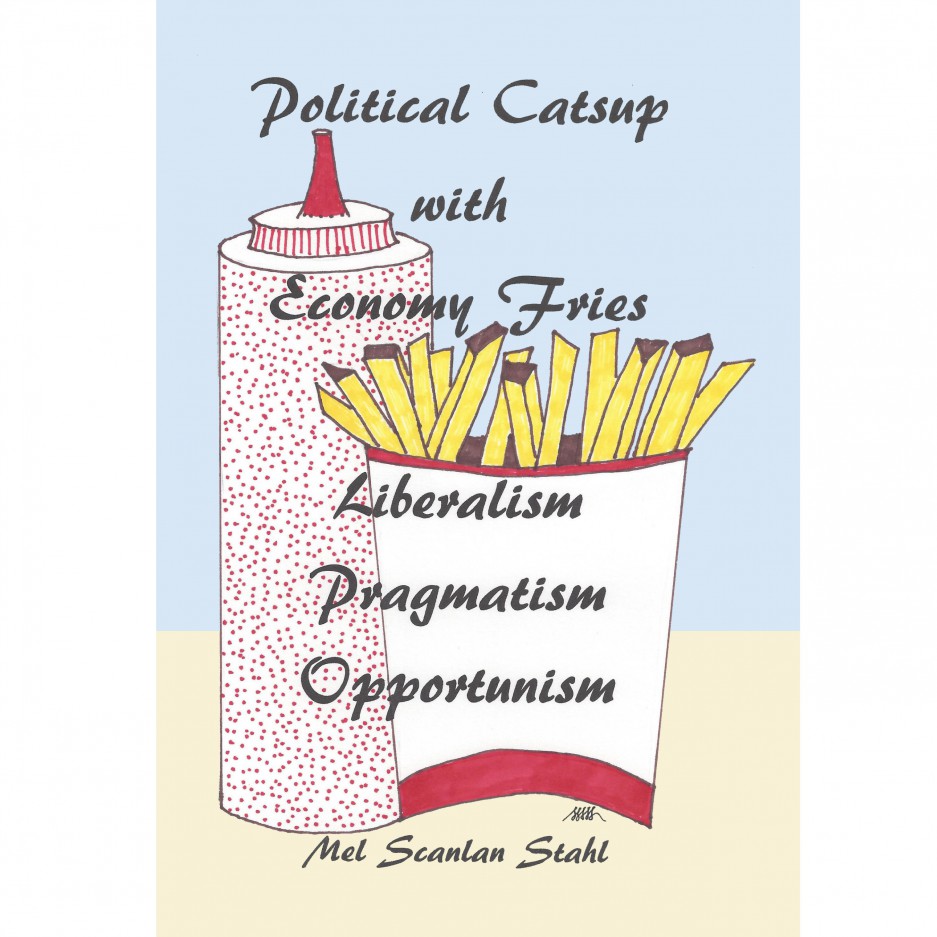
If you want to increase your awareness of the neoliberal age, then buy a copy of Political Catsup with Economy Fries available at Amazon.com.  I explain neoliberalism’s origins, timing and how it grew to become so influential. I identify the people who brought in neoliberal ideas in economics and how neoliberalism affected American politics.

Walter Lippmann warned us in The Good Society.

The Good Society was originally published by Little Brown and Company in 1937.  In it, Walter Lippmann argued that modern liberalism is better than communism or fascism.  Modern liberalism was the dominant American political ideology from after the American Civil War until World War II ended.  Lippmann tried to make modern liberalism, a mild form of socialism, seem like a modern political approach that was unlike other forms of collectivism.  He imagined that American courts could protect Americans from the problems faced in other collectivist societies.  The Good Society may be the best book to explain American modern liberalism.  But it also can help us to understand what has happened after modern liberalism was replaced by neoliberalism.  Here’s a quote from The Good Society that I think describes today’s neoliberal problems that arise when governments operate under the goal of limitless power.

“The predominant teachings of this age are that there are no limits to man’s capacity to govern others and that, therefore, no limitations ought to be imposed upon government.  The older faith, born of long ages of suffering under man’s dominion over man, was that the exercise of unlimited power by men with limited minds and self-regarding prejudices is soon oppressive, reactionary, and corrupt.  The older faith taught that the very condition of progress was the limitation of power to the capacity and virtue of rulers…All the wishing in the world, all the promises based on the assumption that there are available omniscient and loving autocrats, will not call into being men who can plan a future which they are unable to imagine, who can manage a civilization which they are unable to understand.”

To summarize Walter Lippmann, he’s saying that granting more power to our government won’t make government bureaucrats and elected officials smarter or more able than they would be without such terrible power.  Giving them more power doesn’t mean that they will accomplish more.  Americans should keep this in mind when they want our government to tax (others) more and do more (for their friends or themselves).  With twenty trillion dollars of debt, our government can’t do whatever people imagine it can do for them.  Twenty trillion dollars in the hole and an economy that still hasn’t recovered since the Great Recession is a lot of failure.

Wish fulfillment isn’t what a government does, anyway.  And that is especially true with twenty trillion dollars of debt.  I have been puzzled to hear political proposals for free tuition and free healthcare.  We can see that neither goal has been realized.  Warfare in the Middle East can’t continue either.  Neoliberals have tried to externalize corporate and government spending to ordinary Americans.  They risk capital in risky ventures backed up by tax payer dollars (remember the sub-prime mortgage crisis: unqualified borrowers, debt default, tax money instead of bank failure).   Such mal-investment wastes society’s resources as much as war and failed government programs do.  In fact, by imagining endless power by printing more money (a policy that has failed with horrible results many times over history), American political and economic policies have veered off from trying to accomplish what’s possible to striving for what’s impossible.  Just look at the mess that our policies are causing.

Most people understand that “there’s no sense crying over spilled milk.”  That after the milk has spilled it has gone to waste.  Most people understand that a person’s opportunity can be wasted or an investment that hasn’t paid off has been wasted.  And after it’s wasted, its value isn’t still obtainable.  When our economy isn’t working well to build prosperity, money that a healthy economy might have created isn’t hiding somewhere, it’s gone.  When you consider how many working age people aren’t employed in the U.S., that represents a waste.  Isn’t it time to change what’s not working?

Walter Lippmann, The Good Society, Transaction Publishers, New Brunswick, New Jersey, USA, 2005, 40-41.

If you want to read more about Walter Lippmann, he is featured in Political Catsup with Economy Fries, which will bring you up to speed on American political ideologies and their everyday resonances in today’s politics.  Just go to Amazon.com and order your copy today.

Thirst in the infotainment news desert.

There are plenty of news sites available on the internet.  I don’t like them.  I want them to omit entertainment fluff and get down to information that I can use.  Stop abusing my thinking-brain with horrible empty content.  I hate stories that don’t help any Americans to understand better about what’s happening to us all in the twenty-first century.  There are topics galore that are being neglected.  Here are some examples.

How about telling Americans what happens to workers and non-workers in a shrinking economy that has fewer jobs?  What policies and circumstances caused those fewer jobs?  Please show evidence.  Are we seeing the destruction of the market economy?  What kind of economy can take its place?

How can the U.S. continue its fiscal overspending and monetarism under the situation we see around us where production has been eclipsed by speculation and opportunity has been shut out by the excessive pursuit of risk?  How about explaining the consequences of mal-invested capital (under a system of financialization and bank deregulation)?  Money has been wasted when it could have been better used.  Can we change our malinvestment habit (by ending financialization and re-regulating banks)?  What are examples of some better uses for American capital?  How can we begin to re-build wealth in the USA?

How about explaining what the “post-industrial economy” is?  What do the Saudis mean when they talk about their “post-oil economic future?”  What will it mean for us?  Is there a new energy economy on the horizon?  How can we each benefit from it?

And please stop talking about how robots have taken over the job market and how hopeless the job horizon is for all of us (American jobs have been diminished mostly through malinvestments like hostile takeovers, and outsourcing, not robots) .  Financialization and tax rules that consider asset depreciation have encouraged the purchase of robots in the car industry.  But without low-interest loans and tax breaks, assembly-line robots probably wouldn’t have made sense (so that’s a policy issue involving economic interventionism).  And without these added costs from robotics, would cars be cheaper (so would you have a newer car)?

And a lot of work needs to get done that robots can’t do.  Robots lack human dexterity and computers aren’t intelligent (they haven’t passed the Turing Test).  While it’s true that the telephone, electrical grid and sewage treatment plants of the world have been revolutionized by microprocessors, a microprocessor is a very small and humble kind of switch that isn’t a robot.  To call a microprocessor a robot seems to me an exaggeration.

Microprocessors have taken over telephone switching, and electrical plant operations and water treatment centers so that fewer people are needed to operate those facilities.  But those microprocessors are vulnerable in the case of an electromagnetic pulse.  They aren’t a replacement that is as reliable as a person.  And hardening those systems isn’t considered affordable (without a government program that pays for the upgrade) by the private companies that have adopted microprocessors.  Private companies have cut their costs to increase their profits by using microprocessors, but in doing that, they have made our electrical, communication and water treatment systems vulnerable.

New opportunities that aren’t present in a centralized economy could rejuvenate our cities if small business taxes are reduced.  Bad policies like high taxes that harm innovation don’t have to continue.  How about declassifying new technologies and opening them up for private development?  If you would like to understand how we got to our American political and economic here and now, buy a copy of Political Catsup with Economy Fries available at Amazon.com right now.

To learn about EMP threats see: “Report of the Commission to Assess the Treat to the United States from Electromagnetic (EMP) Attack: Critical National Infrastructures,” Dr. John S. Foster, Jr., Mr. Earl Gjelde, Dr. William R. Graham (Chairman), et al, April 2008.

Immigrants in a shrinking economy.

Americans are known around the world for their acceptance and welcoming of immigrants.  So why controversy now?  I think that it’s the shrinking economy.  The U.S. Government is reporting a low percentage of economic growth but the government adds government spending to the GDP numbers even when that spending represents debt (a Keynesian strategy).  And debt isn’t really any kind of production that indicates growth.  I don’t see significant growth in the U.S. economy that would matter to families in metrics such as employment (for example an abundance of well-paying and secure full-time jobs that allow a family to enjoy some economic security), home ownership (right now home-ownership is the lowest it’s been in fifty years), real estate construction (it has not recovered since the subprime mortgage crisis), car purchases (the average age of the American car is 11.5 years), small business start-ups (many have closed), etc.  While there’s capital growth in the stock market because of Federal Reserve market interference, it doesn’t represent real market demand.  Quantitative easing and corporate stock buy-backs have plumped up the stock market.

There are more than a single group of immigrants.  For example, within the scope of this discussion, there are H1-b applicants who have an education and there are refugees with or without an education.  But without economic growth, immigrants aren’t likely to find lasting prosperity here.  And neither are some Americans who live here already.  Most Americans know that it’s a bad idea to bring more people into the nation when there are already not enough jobs to go around.  It seems like a bad idea, too, to bring impoverished immigrant refugees to cities like Detroit, where people haven’t experienced a healthy economy in decades.

One issue is when neoliberals have wanted to use debt or taxes to educate people from other nations and then hire them to fill technical jobs here.  There’s a myth that Americans holding technical degrees aren’t unemployed in the U.S. but that isn’t true.  How many times have you heard that people who can’t find a job aren’t qualified because they don’t have a degree (so it’s their fault)?  Or that people with a college education are more likely to find work whereas those without a degree can’t?  There are plenty of unemployed engineers, mathematicians and scientists all over the United States.  And an employer will often hire a younger immigrant at a lower wage than an older and more experienced American STEM worker would be able to earn.  That shortens the usefulness of a STEM degree and kicks experienced workers out the door.

Neoliberals can get foreign workers who have been educated in the U.S. and then pay them less than they would pay American technical workers.  And doing that undercuts the opportunities of Americans in two ways.  First, by providing government scholarships to educate foreigners when many Americans can’t afford tuition and second by letting those same people replace Americans in the workforce.  Even if a foreigner was educated in a foreign university so that American taxes didn’t pay for their education, they shouldn’t be hired in place of a qualified American worker.  Original H1-b guidelines prohibited that.  And using foreign laborers also brings in people who may accept workplace behaviors outside the norm because they don’t know what’s normal here.

According to Karl Denninger writing from MarketTicker.com, there’s been HI-b visa abuse across America for too long.  Since the 1970’s, neoliberals have used labor arbitrage to lower their production costs by going abroad to get cheaper workers.  We call that “out-sourcing.”  For a while now, American corporations, especially in Silicon Valley, have wanted to reduce labor costs in the U.S. by using HI-b visas to bring cheaper foreign workers here.  This practice displaces qualified American candidates, even though the H1-b visa program is supposed to avoid displacing the qualified American worker.  Denninger says, “…as a direct consequence of the abuses I can not recommend to any teen today that they go into a STEM field, particularly a computer related field.”  H1-b abuses have been destroying American job opportunities for years and they should be stopped.  President Trump should stop these abuses and he seems to be aware of these problems.

Americans will probably return to a renewed acceptance of immigrants when the economy is growing again.  But for now, I think that there’s little mystery in the growing American attitude against HI-b visas.  While importing cheaper scientists, mathematicians and engineers might make it cheaper for employers, it undercuts the American STEM workforce.  Are there any STEM job opportunities in America for a fresh American graduate?  How about for an older engineer, scientist or mathematician who was educated twenty years ago?  Because it’s not clear where a job with job security exists that will provide a return on an American scientist’s, engineer’s or mathematician’s educational investment.

To conclude, H1-b visa abuses should stop even though corporatists enjoy a savings in wage costs.  Impoverished refugees probably shouldn’t be introduced to already impoverished American cities.  Because it causes unnecessary suffering among displaced American workers and foreigners won’t always find a job that lasts.  Refugees from the Middle East are suffering in part because of failed neoliberal military policies of making war in the Middle East.  I would like for the U.S. to stop interfering in the Middle East by bombing it or using drones.  These methods have caused catastrophes that have harmed Middle Eastern families and created the refugee crisis which has only worsened under these terrible policies.

If you want to get some statistics and references to support the statements I just made, then buy Political Catsup with Economy Fries at Amazon.com where I discuss these very same issues and others that explain how we got to our current place in economics and politics in the United States.

To read the article written by Karl Denninger, “H1b Abuse and Reform: Destroy Those Who Speak Against,” see http://market-ticker.org/akcs-www?post=231801, accessed 03 Feb 2017.

There’s another great article on H1-b visa abuses by Norm Matloff that I found on the Economic Populist.  Here’s the reference:

Norm Matloff, “H-1B and Related Guest Worker Visa Reform,” http://www.economicpopulist.org/content/h-1b-and-related-guest-worker-visa-reform-6043, Dec 15, 2017, accessed Feb 15, 2017.

Get your news directly from the source.

If you’re tired of bias and errors in the media’s reporting,  you have an alternative.  You can still be a responsible citizen monitoring the news of the nation.  Just go to Visitor Access Records/www.whitehouse.gov., where you can find rebuttals to phony press coverage and you can also get details on what’s really happening and what’s new under the new Presidential administration.   You can discover the latest news about executive orders.  You can keep up on what President Trump is saying and doing.  So far, it seems that he’s keeping his campaign promises in his early executive actions.  And he’s directing his comments to the American worker and not-working-citizen who would be working if a job were available for them.  So you’ll know what’s happening in your country.  So far, President Donald Trump has his feet on the ground and his feet are in motion.  Go Trump, Go!  It’s such a relief as compared with the frozen policies under the last president.

I have visited http://www.whitehouse.gov to catch up on what President Trump is doing.  I am hoping that the economy can improve under his leadership.  He is appears to be a neoliberal from the corporate group instead of one from the political/lawyer group.  Neoliberalism is government sponsored corporatism.  It remains to be seen whether he will stick to neoliberal tools that strive to control and manipulate economic outcomes.  Those very same tools haven’t been working well for the United States or for the rest of the globe.  Will a better trade balance be enough to restore prosperity?  Stay up to date by visiting this site.  And for more information about how we got to our current political and economic reality, buy a copy of Political Catsup with Economy Fries available at Amazon.com.

Algorithms affect your opportunities.

“Opportunity is what connects the politic and the economy; political policies affect people’s opportunities.” (1)

Nowadays, algorithms can also affect people’s economic opportunities.  I know about how algorithms can affect economic opportunities thanks mostly to Cathy O’Neil and her book, Weapons of Math Destruction: How Big Data Increases Inequality and Threatens Democracy (2).  But there’s been mention of algorithms and their effect on people’s chances in two other books I’ve read since the Great Recession: All the Devils Are Here: The Hidden History of the Financial Crisisby Bethany McLean and Joe Nocera (3) and Who Owns the Future? by Jaron Lanier (4).  These books reveal that math formulas are being used to sort huge quantities of information, also called “big data”.  And these formulas can have uneven consequences to the wider economy when they are implemented.  That is to say that some groups will benefit from the use of these formulas and others might suffer.

Here are some examples:

Algorithms have affected everyone in big and small ways.  The Great Recession happened when risk model algorithms looked back only fifty years to estimate mortgage risk.  That fifty year window of time underestimated risk in subprime mortgages.  If the algorithm had gone back 100 years, there would have been a higher risk estimate.  Also, securitization had already moved risk from lenders to investors in the stock market (including municipal bond investors and retirement fund investors).  The Greenspan put was Greenspan’s promise to Wall Street that the Federal Reserve (and Treasury) would help in case of a stock market default on debt.  The Greenspan put spread Wall Street’s risk to Main Street.  But the risk was multiplied when derivatives were brought into existence.  And derivatives like credit default swaps had algorithms based on probability theory that assumed that more diversification was automatically less risky.  And that idea becomes bogus when unqualified buyers are provided loans that they can’t afford to pay.

Good American teachers have sometimes been fired when they couldn’t meet the No-Child-Left-Behind algorithm’s expectations of learning based on testing.  Some teachers have gamed the test, little realizing that they doomed the next teacher in line who couldn’t make up for an algorithm that had a wrong expectation that was based on a prior deception.  Many school districts have been subjected to these federal programs and they account for de-skilling in the teaching profession where teachers are expected to teach their students to pass tests instead of to think critically.  These algorithms may account for the shortages of teachers across the nation.

The Society for Human Resource Management claims in their report from October 12th, 2016, “Big data methods are being used in the employment setting.”  The report states “that 32% of HR professionals reported that their organization uses big data to support HR.”(5)  According to Cathy O’Neil, 60%-70% of prospective employees are subjected to personality testing when they apply for a job (2).

There are a lot of examples of how algorithms are affecting people’s economic opportunities.  From causing harm in the real estate market (30% loss of value initially and now lowest home ownership in 50 years) and banking sector (remember hundreds of failed banks during the Great Recession), to creating strife in the teaching profession, to evaluating employees based on hidden criteria that can disqualify a person and ruin their chance to get a job.  Parole boards can use algorithms to evaluate risk of re-offense.  Prisoners fill out a questionnaire and their answers tend to disqualify poor people in poor neighborhoods (2).

What’s so strange about avalanches of change caused by big data and algorithms is how little discussion is happening in the wake of catastrophies.  No one seems liable for the harms that algorithms are causing society or causing individuals.  Society is part of a grand experiment where algorithms are creating harms and no one is being blamed for them.  Algorithms can be stealthy ways to ruin people’s opportunity in the American landscape.

If you want to learn about how Americans find themselves in our current political and economic environment, there’s a book that outlines it for you: Political Catsup with Economy Fries, available at Amazon.com.

(1)     Mel Scanlan Stahl, Political Catsup with Economy Fries: Liberalism, Pragmatism, Opportunism, (Fast Car Publishing, Spokane, WA, 2015), 102.

(2)     Cathy O’Neil, Weapons of Math Destruction: How Big Data Increases Inequality and Threatens Democracy, (Crown Publishing Group, New York, 2016).

(3)     Bethany McLean and Joe Nocera, All the Devils Are Here: The Hidden History of the Financial Crisis, (Penguin Group, New York, 2010, 2011).

(4)     Jaron Lanier, Who Owns the Future?, (Simon and Schuster Paperbacks, New York, 2013).

(5)     Eric Dunleavy, Ph.D, Society for Human Resource Management, “Statement of Eric Dunleavy, Ph.D.,” October 12, 2016, http://www.shrm.org/hr-today/public-policy-issues/Documents/EEOC%20Testimony %20on%20Big%20in%20Employment.pdf, accessed Nov. 2016.

Now we see what happens.

Donald Trump will be the forty-fifth President of the United States and he isn’t what the establishment wants.  There are some establishment tantrums happening today, November 9th.  Long faces peer out from the news-desks.  And there are some doom-sayers who want to frown on the mere possibility of real change.  Change is what neoliberals hate and resist.  Will Washington D.C.’s corruption diminish now?  Here we are waiting to see what will happen.  Will Donald Trump disappoint us or will he be a catalyst for needed change?

Dr. Ben Carson said that change won’t come easy with so much debt everywhere you look. From the federal government to the state governments to the municipal governments, and among corporations, banks and individuals, debt is easy to find.  And debt has been the heavy and large stone that stands in the middle of the road for change that we now embark upon.  Change is needed because neoliberal public private partnerships invite economic inefficiencies that are destroying the nation. A centralized economy is an inefficient one.

As with Brexit, the media ignores the real problems in our economy.  These problems  gathered momentum after banking deregulation.  Wall Street preferred Hilary Clinton because she supported their continuance of business as usual.  Will Donald Trump appreciate that banking deregulation has caused imbalances?  Banking and government can’t create prosperity by using zero interest rate policy.  The usual rate of interest in the U.S. over its history has been about 5%.  Zero interest rate policy punishes savers instead of letting interest rates incentivize more savings.  Savings that can be used for investing, for charity, for taking care of people who are too old to work by letting them live off the interest that grows from money they have saved for their later life.  And deregulation has led to all kinds of mal-investments.

The energy of change will necessarily affect the banking industry because it has been “easy money” that has created our current economic imbalances.  Here it comes again: Federal Reserve Policy Failure.   Federal Reserve policies have failed to protect prosperity.  Government statistics have been misrepresenting economic suffering and disguising the need for change.  But change is on its way.  And change would come even without Donald Trump.  But maybe Mr. Trump can give us an easier road.  I am hoping today for an economic road that takes a turn for the better before a complete economic failure strips away what’s left of America’s hard-won past prosperity and know-how.

Let’s be kind to each other during the stressful changes that await us all.  Let’s hope that change through policy reforms can get us on a better path that leads to economic production instead of speculation.  Let’s put an end to hot money migration.  Lets reform the work environment by incentivizing the good worker to work well.  Let’s improve the economy and end pressure on American labor.  Let an end come to de-skilling the workplace.  Let an end come to bullying American workers with lower wages, layoffs and flexibilization.  It’s been wrong to externalize corporate losses to the poorest and most vulnerable capital holders.  Since 2007, risk has pervaded every American’s economic decisions.  Prosperity has evaded the hardest workers.  People can’t find a way to plug into the merciless neoliberal economy where all the rewards go to the people at the top in a rigged system.  Enough already.

Smear campaign?

I went to NPR to read their article: by Danielle Kurtzleben, “1 More Woman Accuses Trump Of Inappropriate Sexual conduct.  Here’s the Full List.”  (http://www.npr.org/2016/10/13/497799354/a-list-of-donald-trumps-accusers-of-inappropriate-sexual-conduct) to make an inquiry of my own and check it over for distortions or patterns.  Thank you to NPR for publishing the information.

There are 14 present-day accusers who have never pressed charges in court for sexual assault against Donald Trump.  I discovered that one woman, Jill Harth filed a suit for sexual harassment but she withdrew it.  And her sexual harassment lawsuit happened two years after her husband Mr. Houraney had also filed a lawsuit for breach of contract against Donald Trump.  They were pageant promoters.  And the suit settled for only law fees and it demonstrates a time lag.  (The prior lawsuit for breach of contract begs the question as to whether it was the real motivator for the sexual harassment charge.)  Similarly, Ivana Trump’s accusations were part of a divorce proceeding and she later retracted them.

Allegations that are surfacing now include time lags.  If I counted right, most of the allegations that involved unwanted sexual attention go back more than fifteen years.  Newer stories from Pageant contestants that claim that Trump entered their group’s dressing room when he should not have done so are more recent but only one or two contestants have claimed that Trump sexually harassed them.  Trump admitted that he entered the dressing rooms during the pageants on the Howard Stern radio show.

When I looked for conflicting accounts to some of these stories, I found several of them.  Anthony Gillerthorpe, a passenger who was present with Jessica Leeds and Trump in the early 1980’s airline flight claims that she was flirting with him more than he was flirting with her and that nothing inappropriate happened that he witnessed.  A family member said that Rachel Crooks, an accuser who now says that Trump kissed her inappropriately, failed to get help from Trump for her modeling career but that she had praised him in the past when speaking to her relatives because she expected that he would help her.

There have been eleven neutral statements from contestants or statements saying there was no harm done regarding Trump’s visiting the dressing-room behavior.  Carrie Prejean, the former Miss California, was quoted on truth&satire.com as having refused to be interviewed by the New York Times and she said that they mischaracterized what little she told them.  Rowanne Brewer, a former Trump girlfriend, also said that the New York Times lied about what she said.  Both of these women aren’t listed by NPR.  Kristin Anderson, according to heavy.com, was contacted by the Washington Post and she said that she doesn’t clearly recall the incident that was described by the Post.  In fact she doesn’t recall who she was with at the time the events happened, though she was out with friends.  And the Post reporter had to supply the name of the restaurant in order to jog her memory.

Mindy McGillivray changed her mind from describing a nudge to describing a grope–and she admitted that she didn’t see who touched her, saying that Trump was behind her but not looking at her.  Trump’s former butler on gotnews.com, denies that Trump made a pass at Natasha Stoynoff even though she says that he, the butler, had to pull her away from Trump’s sexual advances.  And according to him, she and Trump were in a glass room and he would have seen anything that happened in there.  Summer Zervos who has come out recently as a Trump accuser sent him an e-mail inviting him to her restaurant earlier this year, in March.  So I doubt that she was harmed by him in the past.

None of these fourteen women have accused Trump of sexual assault.  According to the Department of Justice, the definition of sexual assault is: “Sexual assault is any type of sexual contact or behavior that occurs without the explicit consent of the recipient. Falling under the definition of sexual assault are sexual activities such as forced sexual intercourse, forcible sodomy, child molestation, incest, fondling, and attempted rape.”  One accusation is that of sexual harassment in the context of the workplace during pageants.  But because there were so many contradicting testimonies, it may be the case that some women were offended by Trump’s behavior and others weren’t.

Unfortunately, there are just so many categories of sexual behaviors including: unwanted sexual attention, inappropriate sexual attention, sexual harassment and sexual assault.  Different states categorize sexual behaviors differently depending upon issues such as whether a person is able to give consent because of their age and their sobriety and also what kind of sexual activity took place.  Sexual violence is considered a criminal act and no one should be victimized.  Adults can say “no” to unwanted sexual attention. I’m listing resources below to help in clarifying these issues.

To conclude, I have to admit that I possess little certainty about what I read online.  Reporters in the past followed-up their stories with multiple sources that might support more than one viewpoint.  But not now.  I will say that I think these accusations are motivated by politics.   I think that because of the way that the locker-room talk which was recorded in 2005, was held back until the moment when Hillary Clinton was slipping in the election polling.  And because reporters solicited these women’s stories.  And because none of them accused Trump through the courts unless they had an additional coincident legal interest.  And because so much time has passed since many of the events that are being described.  We are watching and hearing a smear campaign.  We can see political utility in defaming Trump in order to give the victory to Hillary Clinton, who is Wall Street’s favorite candidate.  Many of the accusations have been disputed.  I’m sure some women were offended.  What should it mean for American politics?  Perhaps nothing.

A lot is at stake in this election.  Think of the dollars tied up in derivatives right now and how the stock market is being artificially inflated by the Federal Reserve.  Recall that corporations are heavily in debt as are cities, states and the federal government.  There’s both private debt and public debt.  And there isn’t enough money to pay all the debts.  Upsetting the status quo could lead to faster financial ruin for some powerful interests.  But financial ruin has been consuming people’s homes and fortunes on Main Street for many years now.  And many businesses have also failed.  If we continue along our present course, many more Main Street interests will be destroyed.  Money has motivated some underhanded tactics as we have learned through Wikileaks when Bernie Sanders’ campaign was undermined by the DNC. Apparently, the DNC also hired people to disrupt Republican primaries.  And there may have been some election fraud in counting votes during the Democratic primaries.

Here are some resources to help you to sort through it all:

Danielle Kurtzleben, NPR, “1 More Woman Accuses Trump Of Inappropriate Sexual Conduct.  Here’s The Full List.  www.npr.org/10/13/497799354/a-list-of-donald-trumps-accusers-of-inappropriate-sexual-conduct, accessed 20 Oct 2016.

The Definition of Sexual Assault, http://www.justice.gov/ovw/sexualassault.

Factsheets: Sexual Harassment Information for Teens., (what to do and how to get help), http://www.sufreenyc.org/survivors_factsheet_60.html

Marty Klein Ph.D, “Sexual Harassment–Or Unwanted Sexual Attention? Adulthood Requires That We Know When Unexpected Sexual Attention Is Harmless,” http://www.psychologytoday.com/blog/sexualintelligence/ 201206/sexual-harassment-or-unwanted-sexual-attention.

Jim Hoft, HERE IT IS Detailed List of Findings In Wikileaks DNC Document Dump, http://www.thegatewaypundit.com/2016/07/detailed-list-findings-wikileaks-dnc-document-dump/, accessed 20 Oct 2016.

If you would like to understand how we got to the American politics of today, read Political Catsup with Economy Fries, available on Amazon.com.
 

“Kayfabe” describes election press coverage.

I have been a fan of Joan Didion’s writings for a while now.  I have a collection of some of them including her observations about politics.  She has written about our press’ focus on candidate’s personality instead of on political policies.  During her coverage of election politics, personality characterizations were positive fantasies about candidates, for example their idyllic family history or their business success.  But in Political Fictions, she noticed the emptiness of press coverage (see reference below).  She saw that political press coverage had moved into a space that lacked rationality or any discussion about choices.  Election coverage failed to offer thoughtful analysis of political polices either at home or abroad.  No one then (2001) could imagine what consequences our nation would face because of unintelligent considerations about politics.  Political confabulations about personality and non-issues have now led us to the absurd news coverage we face whenever elections roll around.  The only surprise is how political characterizations by the press have become negative in contrast to the idyllic past.

Today I stumbled upon the perfect word to describe our present-day political coverage.  I found this word at Ann Barnhard’t’s website,  www.barnhardt.biz/2016/10/08/post-american-politics-is-kayfabe-the-word-is-kayfabe/  And the word is “kayfabe.”  The author of this site used wikipedia as a resource and explained kayfabe as follows:

“This comes from the world of… professional wrestling. Here is the definition from wiki…

KAYFABE: kayfabe /ˈkeɪfeɪb/ is the portrayal of staged events within the industry as “real” or “true,” specifically the portrayal of competition, rivalries, and relationships between participants as being genuine and not of a staged or pre-determined nature of any kind. Kayfabe has also evolved to become a code word of sorts for maintaining this “reality” within the direct or indirect presence of the general public.”

And that’s what I see in political coverage today.  And maybe even worse than the make-believe world of kayfabe coverage which is phony, is that it’s a kind of pejorative information that makes us all feel bad.  When we watch it we feel bad about the U.S. and about ourselves.  It’s information that is more likely to discourage people than to inform them.  It does this by showing them a kind of politics that is completely irredeemable by any potential to change anything for the better.  The idea being put out there is that bad policies can’t change.

Let’s ignore this ugliness.  Let’s recognize the disrespect this kind of coverage means for the potential of politics to do better in the United States.   The U.S. can adopt better policies that aren’t corrupt and that don’t permit fraud.  We can reform.  And even though kayfabe coverage means something bad for all of us in America and for our American politics generally, its broadcast doesn’t mean that we can’t turn over a new leaf.

We can identify and abandon policies that are bad and we can adopt a better kind of politics that puts all of us and everything on a better footing to improve still more.  Let’s try to see beyond the negative kayfabe coverage as we try to re-center ourselves on the political issues that concern us most and in the hope that our politics can improve as we move forward.  Politics can offer a rebirth of opportunity.  I’ll be voting in the hope that our mistakes can inform us and help us to choose more wisely as we move forward.

If you’d like to obtain quality information about how we got to our current political landscape, if you’d like to see the big landmarks that will help you to understand our American politics, buy a copy of Political Catsup with Economy Fries at Amazon.com.

Source: In addition to the above reference to Ann Barnhardt’s blog and to wikipedia’s “kayfabe” entry, see:

Joan Didion, We Tell Ourselves Stories In Order to Live: Collected Non-Fiction, Political Fictions, Everyman’s Library, (Alfred A. Knopf, NY, 2001).


In a fiat system the big capital holder wins.

Many economists and people who trade in global markets have been interested in the question of whether parties who trade with each other benefit equally. James Mill (the father of J.S. Mill) thought that by increasing the efficiency of markets both parties would benefit equally in global trade. This was proved later, by J.S. Mill to be inaccurate. J.S. Mill formulated the principle of reciprocal demand. Under this principle, the gains from trade are seen to be unequal.

If vendors/producers in a small market trade with a bigger market, the demand for goods in the smaller market will increase and the small market can raise prices and therefore benefit more from the trade. Also as a benefit, the smaller market expands. And that observation makes it seem that the little guy gets to win. But that only works out for the little guy in a sound money system like that sponsored by Great Britain under the strict gold standard. The strict gold standard was the global monetary system in play during the period from the end of the Napoleonic Wars until about the end of WWI. J. S. Mill lived from 1806-1873, during the period of the strict gold standard. And under sound money the little guy could gain from trade in terms of gaining a higher demand for their product.

But what happens under today’s fiat money with mobile capital? In this case, parties with the largest capital can influence the price and value of currencies and commodities more than the little guy can. Periodic instabilities in markets due to hot money coming into and leaving the marketplace can create conditions that favor the acquisition of the little guy’s hard-won gains by the big capital holder. So under this kind of system the big guy with more capital wins. The lesson here is that the global monetary system matters in determining who benefits more from global trade.

Reference: A History of Thought on Economic Integration, by Fritz Machlup, (Columbia Press, NY, and MacMillan Press, Ltd, printed in Great Britain, 1977, 219)

All text on this blog is copyrighted to Mel Scanlan Stahl. If you should refer to my blog posts or blog pages please acknowledge me as the source.